
Israel’s high-tech sector has demonstrated impressive resilience in the face of recent challenges and continues to play a central role in the Israeli economy. As presented in previous Innovation Authority publications, the sector’s contribution to the Israeli economy stems primarily from its human capital which constitutes the core of Israeli high-tech and the engine of its success. Failure to fully realize the high-tech employment potential of all Israel’s population groups will impair the sector’s growth potential. It is essential, therefore, to increase the participation of diverse underrepresented populations in the sector, thereby maximizing the economic and social potential embedded in high-tech employment while, at the same time, expanding the realization of ideas, entrepreneurship, R&D, and growth in the overall Israeli economy.
This marks the fifth year in which the Israel Innovation Authority has published an in-depth analysis of the gender landscape in the high-tech sector. Women remain the largest underrepresented group in high-tech, accounting for one-third of employees in the sector – a figure that has remained unchanged for three decades. This publication consists of several sections: as in previous reports, it presents data on the representation of female high-school and university students in high-tech-related fields as a key determinant of future career choices; it then reviews high-tech employment data, including, for the first time, analyses by age group and an in-depth examination of population integration; the final section addresses gender salary gaps in the sector.
In 2025,1Employment data for 2025 presented in this publication refers to the first three quarters of the year approximately 135,000 women were employed in the Israeli high-tech sector – about 34% of total sector employment. This ratio has remained largely unchanged over the past three decades, a trend similar to other indicators examined in this report, which have also shown little change over the past decade. Examples include the ratio of women in senior high-tech management roles, in startup leadership, and in startup fundraising.
At the same time, gradual and incremental changes can be identified in the gender landscape, and it is important to continue monitoring their long-term effects. For example, the ratio of female undergraduate students in high-tech fields at universities and academic colleges increased from approximately 24% of all students in high-tech fields in the 2010-2011 academic year to about 34% in 2024-2025. Most of this growth occurred in computer science, where the number of female students tripled during this period, reaching approximately 6,000 in the 2024-2025 academic year.
The ratio of women employed in R&D roles also increased – from 24.5% in 2015 to 28.4% of all employees in R&D roles a decade later. The number of women employed in these roles more than doubled, reaching approximately 55,000. In other words, the slow growth in the ratio of women in high-tech is partly attributable to the rapid expansion over the past decade in the total number of students and employees in high-tech – both men and women – making it more difficult to close the gender gap.
In addition, against the backdrop of stagnation in overall high-tech employment, as presented in Innovation Authority publications, the increase in the ratio of women employed in high-tech out of all Israel’s women employees has also stalled following a decade of gradual growth. 5.3% of Israel’s women employees worked in high-tech in 2012. This ratio rose steadily to 7.9% a decade later and has since remained unchanged. Similarly, the number of female students taking the 5-unit computer science matriculation exam increased by approximately 40% between 2017 and 2021 – and has since remained nearly unchanged (as has their ratio of examinees).
For the first time, this publication examines women’s participation in hightech employment by age group. This was done to assess whether career choices in high-tech are shifting among younger cohorts and whether women’s employment potential in the sector is being realized relative to that of men. The data show that women’s high-tech employment increased over roughly a decade across all age groups, with the most significant growth occurring in the 25-34 age group. Relatively speaking, the ratio of women in this age group is higher, accounting for nearly 40% of total high-tech employees (women and men) in this cohort. Overall, about 10% of all employed women in Israel aged 25-34 work in high-tech, compared with approximately 15% of employed men in the same age group. Looking ahead, it is important to continue monitoring employment composition in high-tech by age group, and to examine whether, as this cohort ages, it will maintain its employment ratio in high-tech and thereby contribute to an overall increase in the ratio of women, or whether, due to various constraints, women will eventually leave the sector.
The publication shows that gender salary gaps in high-tech remain significant. In 2023 – the most recent year for which data is available – women employed in high-tech earned an average monthly salary of approximately NIS 23,000. The average salary of men employed in high-tech was nearly 1.5 times higher (approximately NIS 10,200 more per month), reaching about NIS 33,000 per month. Salary gaps were also observed across different occupational fields: in executive and administrative roles, men’s salaries were approximately 48% higher than women’s, while in R&D roles the gap stood at 44%. These findings indicate that the salary gap cannot be explained solely by the relatively lower representation of women in core technological roles within companies.
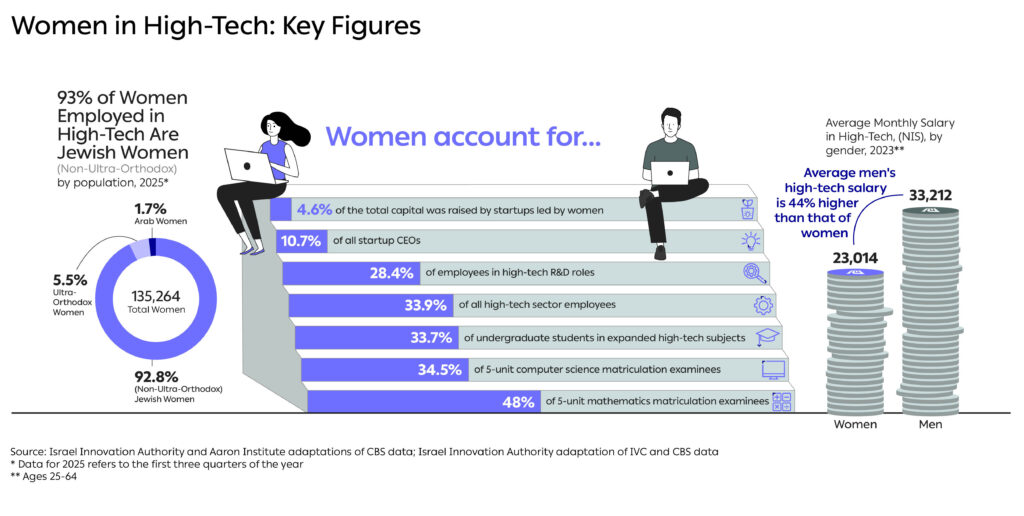
Part of the gap can however be attributed to the relatively low representation of women in managerial positions, which are typically associated with higher salaries. In this publication, women’s ratio at managerial levels is measured using a different dataset than in previous reports, although the findings point to similar gaps: women account for only 16% of development managers and less than 11% of startup CEOs. Given that women’s representation in managerial roles is lower than their overall share in the industry, focused efforts in this area are essential. It should be noted that additional factors, not detailed in this publication, also influence salary gaps. The substantial disparities in salaries highlight the need to continue examining their underlying causes and promote ongoing and transparent measures to bring about their reduction at both the company and sector levels.
Another key gap highlighted in this publication concerns the integration of women from different population groups in high-tech. The number of ultra-Orthodox and Arab women employed in high-tech has grown at a relatively faster rate than that of non-ultra-Orthodox Jewish women. Nevertheless, nearly 93% of female employees in the high-tech sector are non-ultra-Orthodox Jewish women. Ultra-Orthodox women account for approximately 5.5% of female high-tech employees (about half their share of the general population), while Arab women account for less than 2% (roughly one-tenth of their share of the population). Another way to view participation gaps is that 1 in 5 Jewish men is employed in high-tech – compared with 1 in 100 Arab women. These disparities begin as early as matriculation exams. For example, 12.5% of all female students in the Arab education system take the 5-unit mathematics matriculation exam, compared with approximately 17% of female students and about 23% of male students in the Jewish education system.
Based on the data presented above, it is essential to continue monitoring these trends and to initiate targeted interventions at multiple stages – from the beginning of the pipeline and girls’ subject choices in secondary school matriculation exams, which influence their future career paths, to issues related to salary and advancement into managerial roles. Continued efforts to improve high-tech education, led by the Ministry of Education alongside the Council for Higher Education and the Planning and Budgeting Committee, are also critical. At this stage, it is still too early to assess the impact of Artificial Intelligence on employment in high-tech however, given the growing integration of AI tools – particularly in software development – potential gender-related implications should be closely monitored.
As this report shows, persistent gaps in women’s high-tech employment mean that Israel is forfeiting a substantial portion of its society’s ideas and talent. To ensure continued leadership and innovation of the Israeli economy, it is vital to fully realize its existing human capital potential.