Ultra-Orthodox and Arab Women Comprise Less Than 2.5% of High-Tech Employees
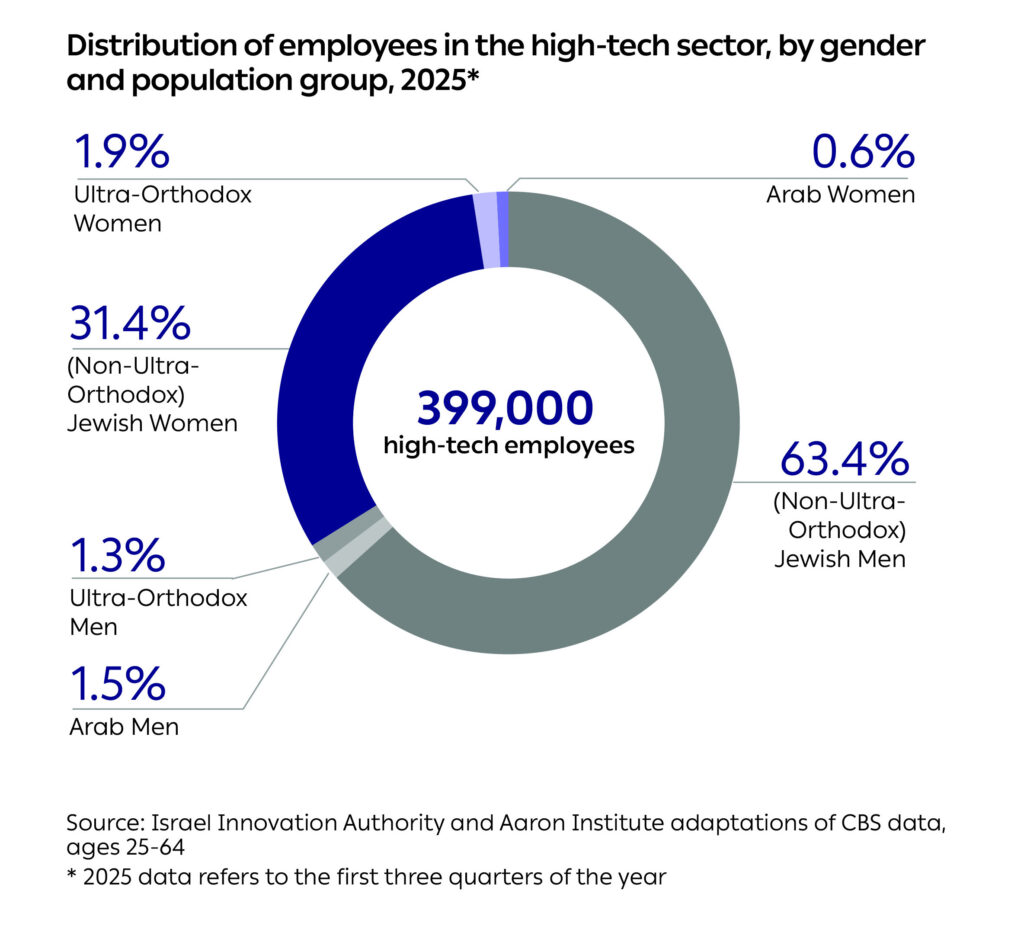
Women from the Arab and ultra-Orthodox sectors continue to be underrepresented in Israeli high-tech. Looking at total high-tech employment, women from these population groups account for less than 2.5% of all employees. Ultra-Orthodox women constitute 1.9% of high-tech employees, while Arab women account for 0.6%.
An examination of the composition of female high-tech employees shows that nearly 93% are non-ultra-Orthodox Jewish women. Ultra-Orthodox women account for approximately 5.5% of female high-tech employees (about half of their ratio of the population) while Arab women account for less than 2% (roughly one-tenth of their ratio of the population).
One in Five Jewish Men Is Employed in High-Tech – Compared with One in a Hundred Arab Women
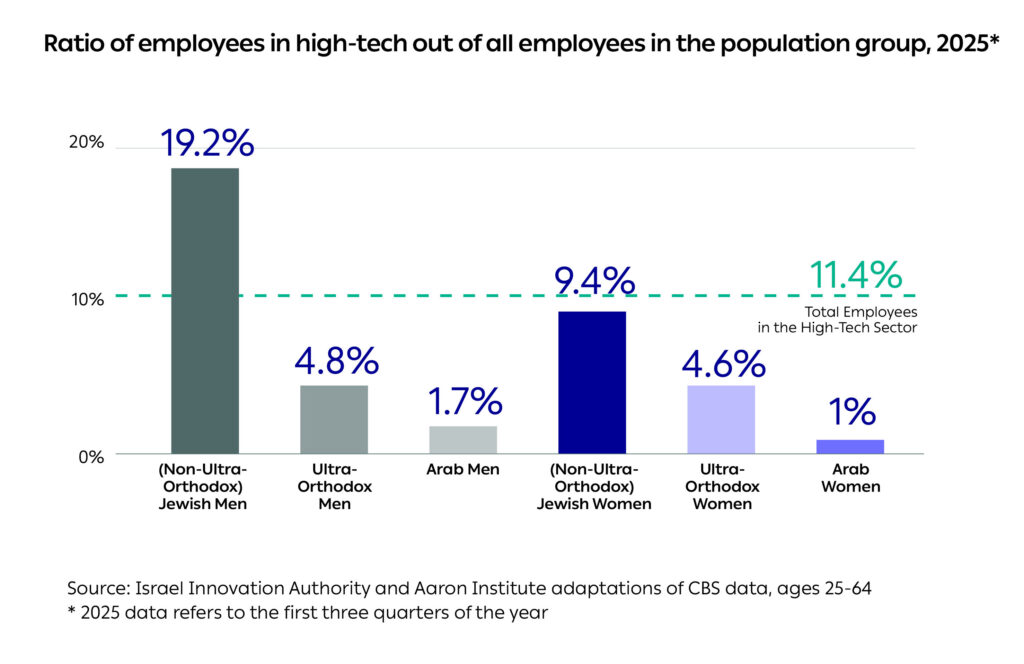
Significant gaps exist in high-tech employment across population groups and genders in Israeli society. Examination of high-tech employment prevalence by population group and gender shows that, overall, while one in five Jewish men is employed in high-tech, only one in one hundred Arab women is a high-tech employee.
Among (non-ultra-Orthodox) Jewish women, fewer than one in ten is employed in high-tech, while among ultra- Orthodox women this ratio stands at 4.6%.
The Number of Ultra-Orthodox and Arab Women Is Growing Rapidly While Their Relative Ratio Remains Low
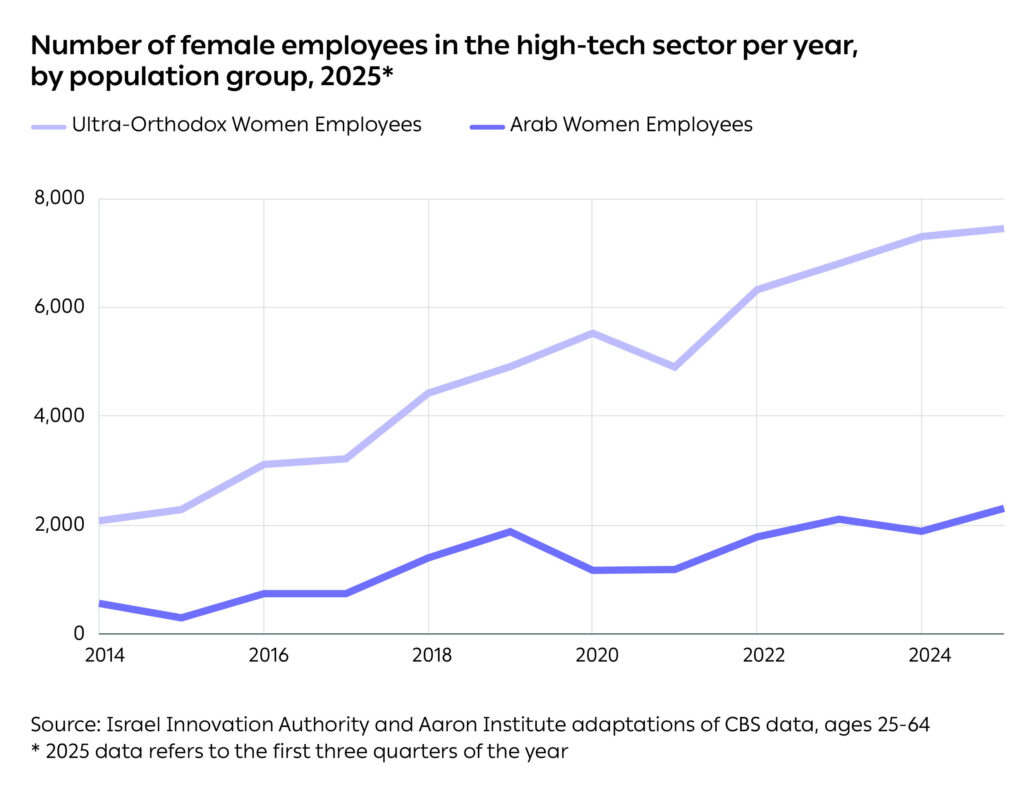
As noted, the ratio of ultra-Orthodox and Arab women in high-tech remains low relative to their share of the population. An analysis of the number of women and their rate of entry into high-tech shows that over roughly a decade, since 2014, the number of ultra-Orthodox women employed in high-tech increased from approximately 2,000 to about 7,500 in 2025 – a 3.6-fold increase. The ratio of ultra- Orthodox women employed in high-tech of all ultra-Orthodox women employees also rose and doubled from 0.9% in 2014 to 1.8% in 2025.
Fewer than 600 Arab women were employed in high-tech in 2014, with their number quadrupling to about 2,300 in 2025.1Data refers to the first three quarters of the year The ratio of Arab women employed in high-tech out of all employed Arab women also rose markedly, tripling in a decade from 0.2% in 2014 to 0.6% in 2025.
In other words, the rate at which women from these two population groups are joining the high-tech sector is significantly higher than that of non-ultra-Orthodox Jewish women. However, as shown above, despite this growth, their relative share of the high-tech population remains low.