
How is the signal generated? How does it arrive? How precise is it? Tabor Electronics develops the electronics that generate and sample the control signals of complex quantum systems
Beyond the hype and the conversation surrounding quantum computing, which tends to focus on qubits, algorithms, and promises of breakthroughs, there is another layer hidden underneath, one without which nothing works: the electronics that drive and control the operation of the quantum processor.
“The real problem does not begin with the quantum processor. It begins much earlier, with the question of how to operate it”, says Ron Glazer, President of Tabor Electronics and founder of TQS (Tabor Quantum Solutions), the company’s division focused on developing components for the quantum field.
“First and foremost, I’m an industrialist”, says Glazer, a successor to the founders of the veteran company that was established decades before the term “quantum computer” entered common use and grew within the world of testing, measurement, and ultra-precise signal generation. Over the years, Tabor became one of the leading suppliers of equipment for generating and sampling signals, including waveform generators, amplifiers, and software solutions that enable highly accurate control over the way signals are created and behave.
Ironically, this experience developed outside the quantum world, became especially relevant once the company entered the sector. “Quantum computing does not begin with the algorithm, but with the signal, with the physical pulses sent to and from the qubits that operate them”, says Glazer. And here, the requirements are extreme: precision in frequency, amplitude, and timing at levels traditional systems are rarely required to achieve.
“Ultimately, everything comes down to signal generation and control”, says Glazer. “How is the signal created or sampled? How, and how quickly, does it arrive? And how accurate and clean is it?” Tabor develops and manufactures the electronics that generate and sample the signals at the level of physical execution. Its systems are designed to send highly precise pulses, measure the response, and maintain stability over time, even as the system itself becomes more complex.
The implications are broad: Tabor is not focused on who will build the most powerful quantum processor, but rather on developing a complete, optimized, and stable control system. In the past, operating a quantum computer required sending a precise sequence of physical signals to the qubits and sampling them back. The signals were not created in a single place, but passed through several different devices, including signal generators, samplers, frequency converters, amplifiers, and control units, each adding delay, noise, or slight deviations. In relatively small systems, this could still be managed, but as the number of qubits increased, so did the number of channels, and complexity rose rapidly.
“If running dozens of qubits once required an entire room full of equipment”, says Glazer, “more than a decade ago, we understood that this could not continue. It simply was not scalable”.
“About nine years ago, we led a dramatic technological shift in the systems of IBM and several other leading technology companies. A unique development based on Direct RF technology created a small, modular, and scalable system that provided a complete, integrated solution in a single, compact, and far more efficient module, rather than relying on a long chain of separate devices. Fewer devices and fewer stages along the way mean less noise, fewer delays, and better control over what actually reaches the qubit”.
“The technology we developed represents a shift in approach”, Glazer emphasizes. “There is a great deal of focus on error correction in quantum computing, but if the signal is not accurate to begin with, you are simply trying to fix a problem that was created earlier. The challenge is not only identifying errors after they occur but also reducing them at the operational stage. This is a transition from a mindset of correcting errors after the fact to one of controlling them in advance, creating a signal that is as clean, stable, and accurate as possible from the outset, so the system starts from a better point”.
This difference becomes even more significant when moving from a small laboratory environment to complex systems. “The moment you move beyond working with a few qubits in the lab and try to build a real system”, says Glazer, “every small issue becomes a challenge that accumulates”. The ability to control signal quality and stability during the qubit decoherence window, even at the earliest stage, becomes essential to operating a quantum system over time.
“The uniqueness of this approach lies in the ability to work at scale”, Glazer argues. “Our technology is designed to operate in synchronization across many channels simultaneously, making it possible to run a large number of qubits in a coordinated manner. This is a necessary condition for moving from small systems to more complex operational environments, where every small deviation can affect the overall result”.
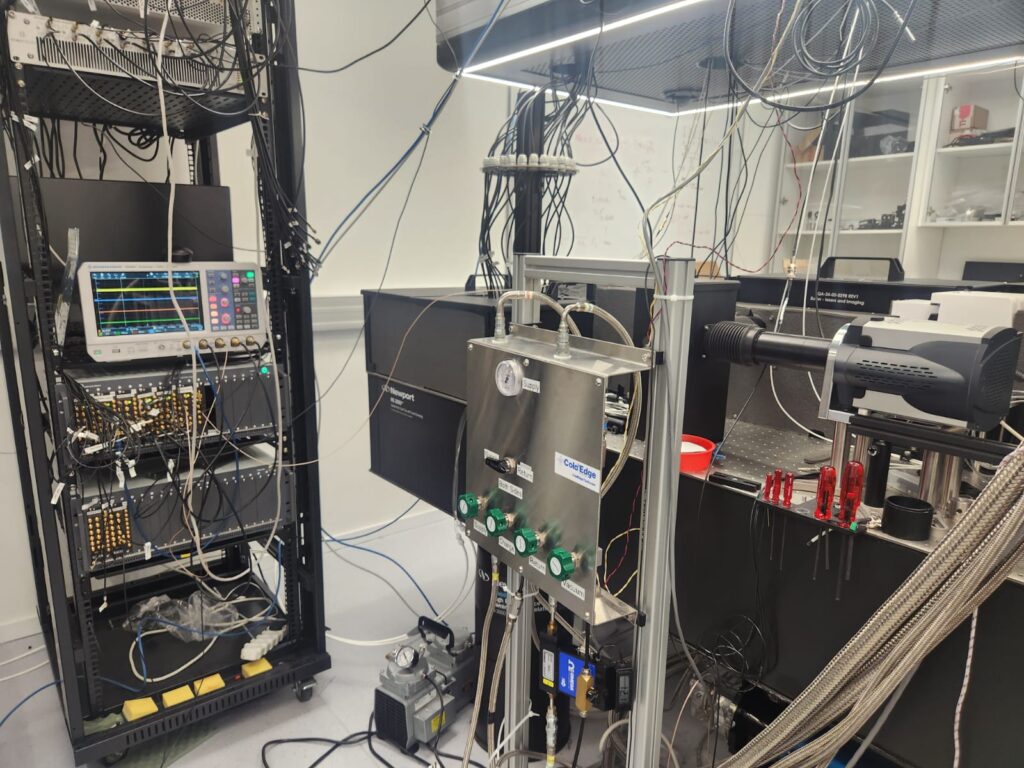
The significance is both technological and economic. For customers, the ability to reduce the number of components and consolidate functions within a single system lowers complexity, reduces costs, and simplifies operation and maintenance. Instead of relying on an expensive and fragmented system that is difficult to scale, they get infrastructure they can grow with. “Our capabilities have led the industry to a significant reduction in control system costs per qubit”, Glazer emphasizes.
“With a system that is not tied to a specific architecture or scale, Tabor can address a broad market, serving a wide range of customers and quantum computing platforms, from research laboratories to companies developing large-scale systems. The result is a platform that can be implemented across different environments and adapted as the systems evolve”.
Glazer attributes long-term cumulative importance to the investment provided by the Innovation Authority. “This is not just financial investment, but the ability to work with academia and with other players in the industry on real systems, and to test solutions under real conditions”.
“The Innovation Authority opened up the possibility for us to introduce the company’s solutions into active working environments, test them within real quantum systems, and adjust them according to what happens in practice, not only under controlled laboratory conditions. This connection between industry, research, and infrastructure enables an ongoing process of experimentation, adaptation, and improvement, which is essential in a field where every small deviation affects the result”.
Glazer sees the Innovation Authority’s investment as a framework that enables long-term progress. For a company coming from the worlds of electronics and measurement, it is a way to connect existing knowledge to new requirements and new markets, and to refine that expertise until it functions within the operational environment of a quantum system.
“Moreover, I’m also pleased to say that every investment we have received from the Israel Innovation Authority has ultimately generated returns”, Glazer adds with satisfaction.
“In deep technologies, the challenge is not always at the core itself, but in what enables the system to function in practice. Our role is to enable companies to develop and test those layers on real systems”.
Dror Bin, CEO of the Israel Innovation Authority