
Quantum Machines (QM) is already developing systems that enable continuous quantum computation aimed at turning a quantum computer into a working machine with potential annual revenues estimated at tens of millions of dollars
Quantum Machines, one of the world’s leading companies in the field, focuses all its capabilities on developing and building control and operation systems (Quantum Control) for quantum computers. The company strategically chose to specialize in this critical layer, also known as “the brain of a quantum computer”, thereby enabling quantum processors (Quantum Processing Units – QPUs) to become consistent and useful computing resources. While many companies are developing quantum processors based on specific technologies, QM is developing a control system that works with all types of quantum processors.
The company was founded by three physicists who, through their work with quantum systems in the lab, understood that the real challenge is not simply performing quantum computation but also ensuring it remains stable and reproducible over time.
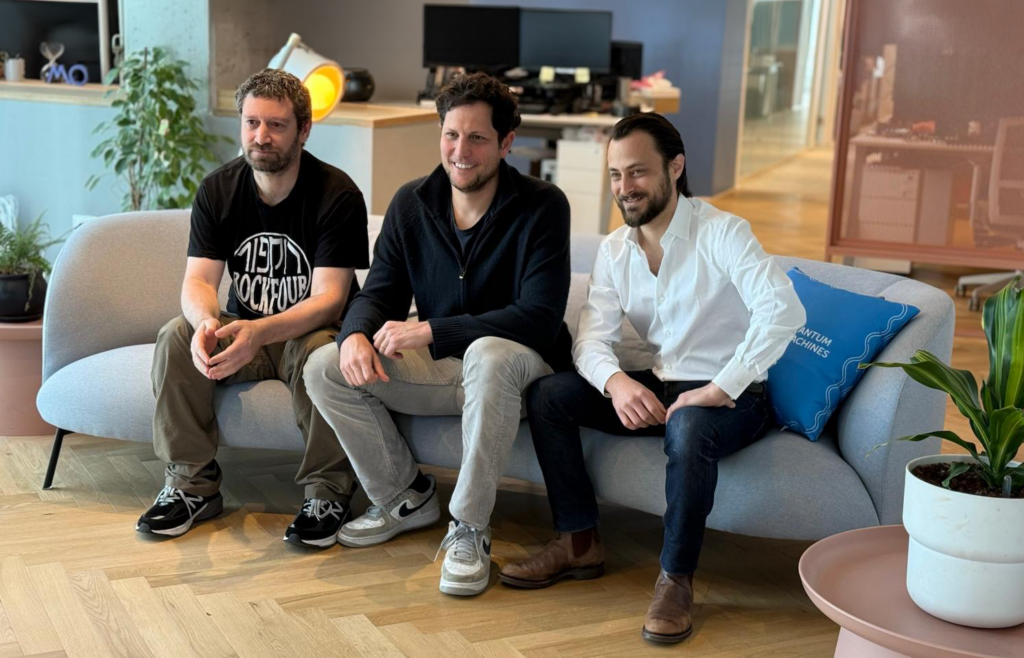
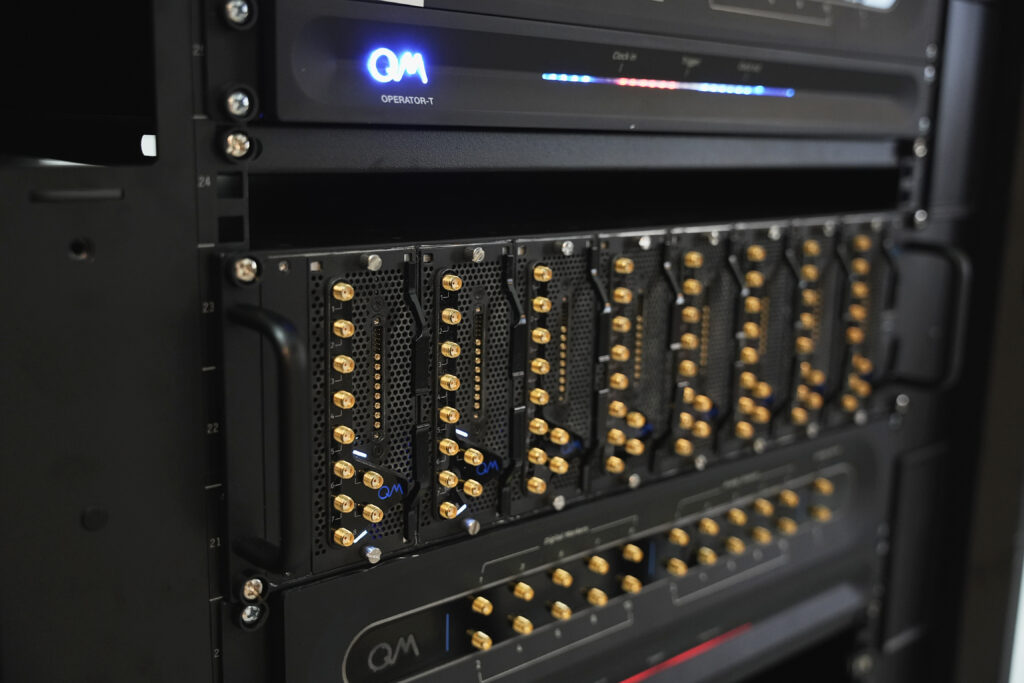
Left: Quantum Machines’ founders:
Dr. Itamar Sivan, CEO;
Dr. Yonatan Cohen, CTO; and Dr. Nissim Ofek, Chief Engineer
Right: OPX1000, Quantum Machines’ control and management system – the “brain” of the quantum computer
“We understood that building the computer was not enough – we also needed to know how to operate it efficiently”, says Itamar Sivan, the company’s CEO and co-founder. “We decided to focus on the way the system is operated, so that it works stably and consistently, with each operation timed precisely and every measurement integrated into the remainder of the computation, to make the results useful”, he adds.
The company’s platform functions much like an operating system for a quantum computer. It does not simply send commands to qubits and measure the results but also processes those results instantly and determines the next computational step in real time. Everything happens in a single sequence, in real time, so the computation doesn’t break down midway but rather progresses continuously.
This capability is based on a hybrid control architecture that seamlessly integrates quantum processors with classical computing systems. The platform supports various types of quantum computers, including superconducting, neutral-atom, spin-based, trapped-ion, and photonic platforms. This clear advantage enables it to work with all types of QPUs without being locked into a specific technological direction in a field whose dominant architecture has yet to be determined.
QM’s hybrid control technology enables precise, efficient execution of some of the most complex computational tasks across all types of quantum computers. This flexibility has led to the rapid adoption of the technology by most quantum computing companies worldwide. The company’s strategic collaboration with NVIDIA strengthened the connection between the quantum and classical worlds, leading QM to announce the Open Acceleration Stack. This open architecture connects classical processors, such as graphics processing units (GPUs) used by AI or CPUs, directly to the company’s control system. This connection enables exceptionally fast communication between the systems, thereby reducing bottlenecks in quantum computing development. Thanks to this technology, both quantum and classical computing resources can work together in full synchronization in real time. This groundbreaking solution is essential for real-time quantum error correction and paves the way for integrating quantum computers into data centers and supercomputers. This connectivity will help address complex challenges in fields such as medicine, energy, and materials that computing power cannot resolve.
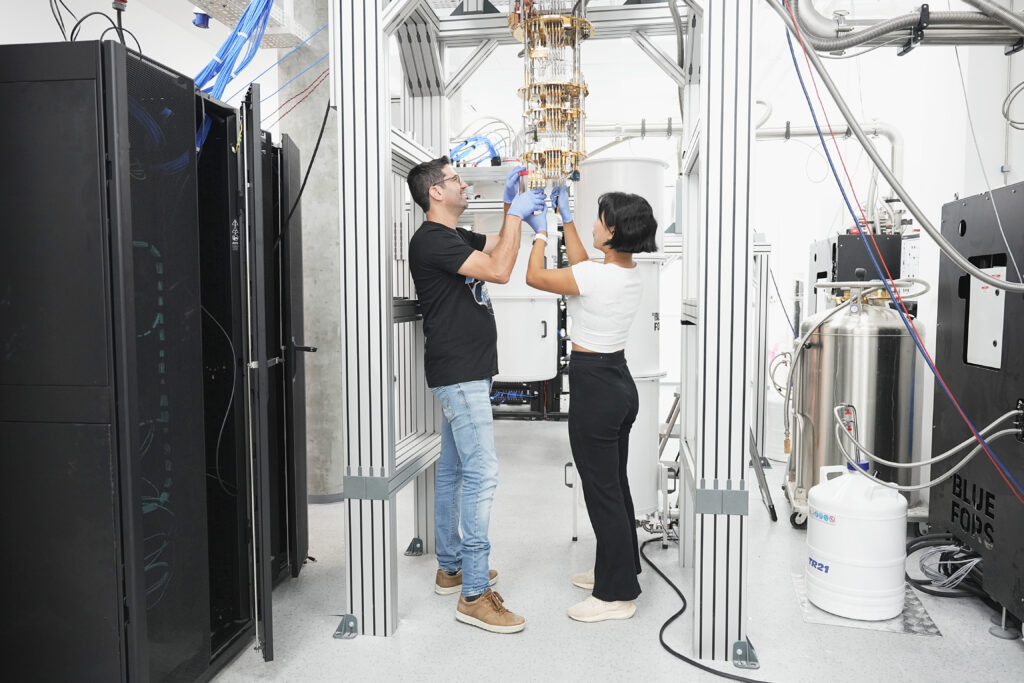
The Quantum Machines team working on a quantum computer at the Israeli Quantum Computing Center (IQCC)
Control and Processing During Computation
The growing number of qubits is matched by the increasing number of operations that must be managed, such as more signals, more measurements, more real-time decisions. Without a system capable of handling this challenge, even an advanced computer struggles to move from one-time experiment to consistent use.
“Computation in a quantum system operates differently from running regular code that produces an answer at the end. Each operation changes the system’s state, and each measurement affects what happens immediately afterward. This means that you can’t simply send commands and wait. You need to be inside the actual process”, Sivan explains. “But you also need to understand things as they happen and respond in real time”.
This is where Quantum Machines’ control system steps in. Instead of extracting data, analyzing it, and then running again, the computation, measurement, and response occur in a single sequence. Each partial result can immediately affect the following step.
To make this happen, the company developed a dedicated processing component, the Pulse Processing Unit (PPU), that performs control and processing functions during computation. The result is not only a faster process but an entirely different type of operation, one that makes it possible to measure, analyze, and progress without stopping the system, creating a single continuous process instead of a series of separate experiments.
Alongside the hardware, the company also developed a dedicated programming language named QUA, that not only enables defining what to do, but also how to respond to events during execution. In other words, instead of a predefined program, it is possible to write logic that updates in real time based on measurements from the system.
The combination of the processing component and the programming language creates an environment in which computation, measurement, and response occur together. The implications are not only technological, but also operational. Calibration, optimization, and control can be performed as part of a continuous process, rather than as a series of separate experiments. This innovation shortens work cycles and enables faster progress.
Its impact extends not only to performance but also to the entire field’s rate of progress. Quantum computing does not advance through a single breakthrough, but rather through thousands of experiments and small improvements. Every delay, whether in data transfer, external analysis, or rerunning an experiment, slows the pace of learning. The ability to respond in real time shortens this cycle and significantly increases the number of experiments conducted within a given time frame.
“Once you shorten the loop between measurement and action, you change the pace of progress”, says Sivan. “It makes it possible to run more experiments, learn faster, and advance at a different pace”.
Sivan describes the company’s work as a layer that, until recently, did not exist in the industry in an organized way. If qubits are the “muscles” of the quantum computer, Quantum Machines’ platform is the “brain” that enables them to work together.
In practice, one of the main obstacles is the difficulty of operating them efficiently. Researchers spent a great deal of time on manual adjustments, calibrating equipment, and rerunning experiments to reach a starting point that enabled the experiment to proceed. Much of the effort was not devoted to the scientific question, but to operating the system itself.
QM’s system translates the algorithm into a precise sequence of signals and actions that activate the qubits and perform the processing. It does not merely run commands but also considers what happens during the process and updates the next steps accordingly. Put simply, without this kind of control, even an advanced quantum computer is not much more than a system that can be turned on, but which is extremely difficult to work with.
Real-time control, however, is only part of the picture. For this capability to truly accelerate progress, it must also be possible to use it continuously. In the quantum world, access is a prerequisite for progress. To improve a system, it must be run again, repeatedly, tested, calibrated, and errors corrected.
“You cannot make progress if you do not have access to systems,” says Itamar Sivan. “If you need to fly halfway around the world for limited access to a system, it simply won’t work”.
This statement describes a reality that was common until recently. Quantum systems were concentrated in a small number of laboratories, and access to them was limited. Researchers had to adapt to short time frames, work under conditions beyond their control, and sometimes wait long periods in between experiments.
Sivan also emphasizes the importance of the Innovation Authority’s investment for the ecosystem and its contribution to creating a work environment that enables collaboration among academia, industry, and infrastructure, thereby helping the field to advance faster.
This approach is also reflected in the infrastructure being built around the field, including the Israel Quantum Computing Center (IQCC), which the company established at Tel Aviv University in conjunction with the Innovation Authority. The center’s goal is to enable ongoing access to real systems, so they can be used, tested, improved, and serve as a basis for building cumulative knowledge.
“Israel has always been strong in deep-tech: the ability to take deep information and transform it into systems that work in the real world. Today’s challenge is not only to develop the physics, but to build the layers that enable us to work effectively on a very large scale”.
Dror Bin, CEO of the Innovation Authority