
The Israeli companies tackling the engineering challenge of building quantum computers are doing so using different technological approaches. Rarely competing against each other. Instead, they operate with a shared sense of “us against the world”
The quantum processor is the core of the computer, a computing unit that operates according to principles of quantum mechanics. It receives a request and produces output like a conventional computer processor; however, its basic unit of computing is a qubit.
To understand what is required of a quantum processor to be practically useful, it is important first to assess the size of the gap between the current state of the technology and the ultimate goal. While quantum computing has the potential to generate more than USD 1 trillion in value for the global economy, realizing that potential will require an extremely large-scale quantum computer, with at least one million qubits and advanced error-correction capabilities.
The largest quantum computer in existence today contains only 1,000-2,000 physical qubits, still three orders of magnitude short of the target at which a quantum computer will demonstrate genuine superiority over a conventional computer. Why are so many qubits needed? The types of problems quantum computers are expected to solve require extremely long calculations involving many sequential operations. Errors can occur at each stage of the process and accumulate throughout the computation.

The higher the qubit’s quality, i.e., the more stable and resistant it is to interference, the fewer errors it produces. But even high-quality qubits still make mistakes, hence the need for a large-scale error-correction system that requires a dramatically larger number of qubits.
Alongside the performance gap, there is also an accessibility problem. Today, quantum computers are large, expensive, and highly complex systems that are primarily accessible to governments and major technology companies. In that sense, the field resembles an earlier era of classical computing, when computer systems were centralized, extremely costly, and available only to a select few.
The Challenge: Creating Interactions Between Photons
Quantum Source has chosen a photonic approach, using photons (particles of light) as the foundation of its quantum processor. “The major advantage of photons is scalability: once you build the right building block, you can replicate it again and again and build a quantum processor as big as you want”, explains Oded Melamed, the company’s CEO and co-founder.
A longstanding challenge in photonic computing is that photons rarely interact with one another naturally. As a result, the central challenge in the photonic approach is the creation of controlled, efficient interactions between photons. In many conventional approaches, individual operations succeed only a fraction of the time and therefore requires numerous repetitions.
The company’s solution, based on research conducted at the Weizmann Institute of Science, uses atoms as intermediaries. “We transfer the quantum information from the photon to the atom, store it there, and when the next photon arrives, transfer the information to that photon”, Melamed explains. “The atoms excel at storing information and act like a kind of needle, weaving the photons that transfer information throughout the system”.
The technology is based on interactions between individual atoms and photons inside a precisely engineered physical structure known as a “cavity”. The interaction enables the generation of photons “on demand” and the creation of controlled connections between them. Instead of attempting to force photons into direct interaction – an extremely difficult task with a very low probability of success – the system uses atoms as mediators to transfer information between them, a deterministic approach that is orders of magnitude more efficient than other photonic approaches.
Quantum Source’s deterministic approach enables direct control over the process. The transition from a probabilistic to a deterministic approach alters the entire system’s characteristics, directly affecting its size, cost, and complexity. While probabilistic systems require massive duplication of components – sometimes on a scale that could lead to computers the size of a football field – the deterministic approach enables a smaller, more efficient, and easier-to-operate system.
Moreover, it also opens the possibility of operating under less extreme conditions. Instead of highly complex cooling systems, it may become possible to design systems that operate at room temperature – a major engineering and economic advantage. Accordingly, the company is focused on building a large-scale, powerful processor rather than intermediate-stage systems. “We are focused solely on the large computers”, says Melamed, “We’re not interested in the intermediary stages”. The goal, he explains, is to build a processor capable of solving problems that no classical computer can solve, and which customers will be willing to pay significant sums to access.
“We are the only company in the world developing quantum computing technology using this approach”, he says. As a result, we have no one to copy from and must chart our own path. The technology remains highly complex, and the road to full realization is not short, but the scientific foundation already exists, it is Israeli, and we are turning it into reality”.
The Innovation Authority has been a Significant Part of the Journey
Melamed attributes considerable importance to the Innovation Authority’s involvement from the earliest days of the company. “We only had three or four team members when we first met with the Authority”, he says. “The Authority representatives encouraged us to move forward, promised to help, and they kept that promise. The Authority supported us through several critical stages over the years: first, in transferring the knowledge from the Weizmann Institute to the company, and later, in developing the core technology on which the company is based.”
One of the most significant outcomes of that collaboration is the Silicon Photonics Consortium, which the company has been leading over the past three years. The consortium includes companies from diverse fields, such as communications, navigation, and powerful lasers such as Elbit, Cielo, and NewPhotonics, each of which uses the evolving technology for its own different applications.
“We may be the only company using this technology for quantum computing”, says Melamed, “but the consortium allows us to develop it in further directions, and right now, we are working on establishing another, more advanced consortium that will expand its activity and include new partners from both industry and academia”.
Melamed emphasizes that, beyond funding, the Innovation Authority’s central value lies in its ability to drive such processes forward. “The Authority had the vision to invest in this field long before it became fashionable”, he says, “and I think that it’s largely thanks to them that we are on the map today”.
“We operate precisely in places where the risk is high, and certainty is low. The rationale is to enable technologies like these to reach the stage where they can actually be used”.
Dr. Alon Stopel, Chairman of the Innovation Authority
A Hybrid System Combining Diamond and Photonics
Shmuel Bachinsky, CEO of Quantum Transistors, presents a unique approach, both in terms of the underlying technology and the overall system architecture. The company is developing a hybrid solution that combines diamond-based qubits with silicon photonics. The qubits are created within a diamond crystal, while the photonics layer provides control, connectivity, and information transfer throughout the system. This combination is not merely a technological choice, but an attempt to bridge two critical requirements: maintaining stability at the qubit level while building an entire system that can be engineered and scaled over time.
The company was founded around an idea developed by physicist Dr. Moshe Tordjman and is currently operating in the research and development stage. Bachinsky himself brings extensive experience from the startup world. “My job is people”, he says, “not physics”, placing the focus not only on how to make the system function, but on how to turn it into a product.
“The qubits themselves are created within a diamond crystal”, Bachinsky explains. “These are nanometric structures, manufactured directly inside a chip, not in isolated laboratory systems. At the same time, the photonics layer enables control, connectivity, and information transfer between the qubits”.
The choice of diamond places the qubit within an exceptionally stable crystal structure, enabling it to be more effectively isolated from its surroundings. The isolation does not eliminate noise but reduces it at the material level, enabling progress under less extreme cooling and isolation conditions.
Reducing the qubits’ sensitivity directly affects engineering complexity, operational costs, and the ability to shrink the overall system. However, the use of diamond is only part of the story. The hybrid architecture also includes substantial activity in silicon photonics, which serves as the system’s connectivity and control layer. The combination of diamond and photonics is deliberate. On the one hand, it allows for qubit stabilization; on the other, it enables the construction of a system that can be connected, expanded, and operated as a unified whole.
The technology is still under development, and the company currently operates in a distinctly research-oriented environment, with a team of around 20 employees. Some of the challenges that initially seemed impossible have already proven feasible, but the road to a finished product still involves significant technological risks.
Quantum computing today resembles the mainframes era (large, expensive, old-generation computers with limited accessibility that occupied entire rooms). The size, cost, and accessibility of the systems limit the field’s ability to build applications with them, slowing the field’s overall pace of development.
Quantum Transistors defines its goal as a quantum computer on a chip: “a quantum computer on a single chip” that can be manufactured, replicated, and assimilated, and a system that can be rerun, connected, expanded, and integrated in larger systems. “In that sense, the question is not only whether the system will work”, says Bachinsky, “but whether it can be manufactured at scale.” He emphasizes that “the holy grail is not just making it work. It’s answering the question as to whether it will be possible to sell a million of them”.
From the Lab to the Production Line
The decision to pursue a hybrid architecture influences not only the system’s design but also the way it is built. At Quantum Transistors, the focus is not only on creating a quantum component but on developing a process that can be replicated and scaled.
To achieve this, the company operates within a manufacturing-oriented framework. Quantum Transistors has established its own internal fabrication facility (fab) where the chips themselves are produced. The facility spans roughly 200 square meters and manufactures micron-sized components using processes similar to those employed in the semiconductor industry.
The fab creates a clear transition point between research and development: Rather than producing demonstrations that function only under laboratory conditions, the company is building components within a defined manufacturing process that can be repeated, improved, and used as the foundation for an entire system. The qubits themselves, for example, are created directly within the chip as part of this process.
“In the quantum world, it is not enough to show that a computation works under certain conditions”, says Bachinsky. “You have to make it work again and again in the same way”.
That level of stability is far from trivial. It requires precise timing of every operation, immediate integration of measurements into the computational sequence, and real-time control over every component in the system.
For Bachinsky, the challenge is not only to build a working system, but to create an entirely new format for quantum computing. “We are trying to build the ‘8086’ of the quantum world”, he says. The ‘8086’ processor, which laid the foundation for personal computers, was not the most powerful processor of its time. But it changed the format and proved that it was possible to transform a capability that was concentrated in massive systems into a component that could be manufactured and distributed.
The road toward realizing that vision remains arduous, and the challenges remain substantial. Nevertheless, the choice to design the system from the outset within a manufacturing framework, rather than purely as an experimental platform, reflects a fundamentally different perspective and end goal.
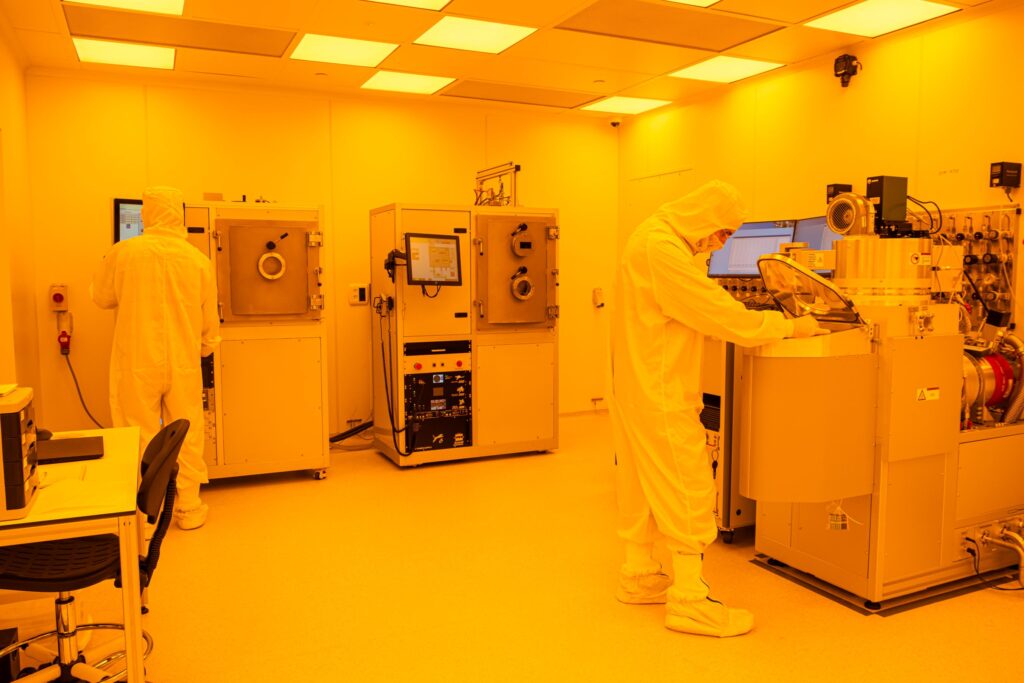
The company’s team at the production facility where diamond-based quantum chips are developed.
Not One Company, but an Infrastructure
“The development of a quantum computer cannot rely solely on a single organization”, Bachinsky emphasizes. Quantum Transistors operates within a broader framework that connects industry and academia around shared challenges. “This is not a story of one company competing against another”, he stresses. “It is about jointly building knowledge, capabilities, and infrastructures that will increase the chance that one of these approaches will eventually lead to an Israeli breakthrough”.
According to Bachinsky, the Innovation Authority creates the conditions that enable this kind of model to exist, connecting organizations that would otherwise not necessarily have worked together and establishing frameworks that allow the simultaneous exploration of multiple technological approaches as part of a broader national effort.
“As part of an initiative led by the Innovation Authority, Quantum Transistors leads a consortium called DiamondSemi-IL, which focuses on developing diamond semiconductor technologies”, Bachinsky explains. The consortium includes ten Israeli companies, among them Rafael, Elbit Sytems, and NVIDIA, as well as eleven academic research groups from across the country. “Our fab enables them all to produce prototypes and share knowledge”, says Bachinsky.
“When the problem is difficult, you want as many minds around the table as possible, and the consortium is an effective way to contend with complexity”, he says. In practice, that means working with researchers and advisors from Israel and abroad, who delve deeply into specific problems and help solve them.
Working within such a framework is not always simple, but Bachinsky is convinced that the outcome justifies the effort. “By advancing several directions simultaneously”, he adds, “we increase the chances that Israel will succeed in developing its own quantum computer, thereby securing national independence in this critical field”.
“There are presently several approaches to building a quantum computer, and a leading technology has yet to emerge. Our role, as a state entity, is to enable multiple directions to develop simultaneously, to develop relevant knowledge in the technology or technologies that will lead in the long-term and enable us to build real capability”.
Aviv Zeevi, VP of Technological Infrastructure, Innovation Authority