
Israel’s QLog took on the operational chaos of hospitals. Minovia took on a disease with fewer than 1,000 patients worldwide. Both succeeded through partnerships with leading European medical centers
Developing a therapy for an ultra-rare disease presents a challenge long before the clinical trial begins. That is because at times fewer than a thousand patients exist worldwide. They are scattered across different countries, treated in different hospitals, and therefore each physician specializing in the disease is familiar with only a handful of cases. In this reality, even a scientific breakthrough is not enough. Demonstrating that a new treatment truly works requires clinical experience drawn from as many patients as possible. – Something no single country can provide. It requires bringing together researchers, hospitals, and patients across borders.
That is exactly the challenge Minovia set out to solve. Founded by Dr. Natalie Yivgi-Ohana, the company is developing a treatment that involves transplanting healthy mitochondria into damaged cells to restore their ability to produce energy. What seemed almost unimaginable just over a decade ago has now entered human clinical trials.
“The fundamental question we asked was simple,” says Dr. Yivgi-Ohana. “If mitochondria are no longer functioning properly, why not transplant healthy ones in their place?”
That idea became Minovia’s starting point. Rather than trying to repair damaged mitochondria, the company is developing a way to introduce healthy mitochondria into affected cells. If the approach proves successful, it could open an entirely new path for treating diseases caused by mitochondrial dysfunction.
Turning that idea into a medical treatment, however, meant proving that it could work in people. Minovia chose to focus on Pearson syndrome, a rare genetic disease caused by mitochondrial dysfunction. Once again, the realities of rare diseases became impossible to ignore. The global patient population is extremely small, with patients dispersed across multiple countries. Meaningful clinical experience cannot be built in a single hospital – or even in a single country.
“When there are so few patients, every collaboration matters,” says Dr. Yivgi-Ohana. “It’s the only way to build the knowledge needed to understand whether the treatment truly works.”
That need led Minovia to seek a research partner with complementary expertise. The laboratory of Prof. Leif Ludwig at Charité – Universitätsmedizin Berlin was a natural choice. Prof. Ludwig had recently published research on the cellular mechanisms underlying Pearson syndrome, and Minovia recognized that the tools developed in his lab could help answer unresolved questions. When the Israel Innovation Authority launched a call for proposals under its International Collaboration program, the relationship that was already taking shape gained the framework needed to become a joint research project.
“This was a project we wanted to pursue regardless,” says Dr. Yivgi-Ohana. “We didn’t have to invent something new or redirect the company simply to secure funding. The Israel Innovation Authority came in and said, “Let’s turn this into a funded collaboration.”
For her, that was the program’s greatest advantage. Instead of investing valuable time and resources in establishing and managing the partnership, the company was able to stay focused on the science.
“A small biotech company has to make sure its resources are directed toward development – not bureaucracy.”
The Israel Innovation Authority’s support made exactly that possible, allowing the joint research to move forward quickly while keeping the company’s efforts focused on its primary mission of developing the treatment.
A Look Inside the Cell
The collaboration with Prof. Ludwig’s laboratory at Charité was not intended to expand Minovia’s network of partners. It was designed to answer the question of what exactly happens inside the cell after the mitochondria is transplanted?
To investigate this, Minovia provided cell samples taken from patients before and after treatment. Prof. Ludwig’s laboratory developed advanced single-cell analysis methods that enabled tracking of transplanted mitochondria and examination of their effects on cellular activity.

“The methods developed by Prof. Ludwig allow us to see which cells took up the mitochondria, how many mitochondria entered each cell, and what biological changes occurred following treatment,” explains Dr. Yivgi-Ohana. “We did not have this level of precision before.”
The data provide a clearer picture of how the treatment works, help refine its continued development, and point to new research questions.
“It is very difficult for a company to do everything,” says Dr. Yivgi-Ohana. “From the first day, we understood that we would focus on patients and on bringing the technology into treatment, but that the research would always be carried out collaboratively. There is no way we can keep pace on our own with every technological advance taking place around the world.”
That approach continues to guide the company today. Every trial raises new questions, and every answer leads to further research. “We receive the data, study them, and then return to the laboratory with new questions,” she says. “The collaboration continues to evolve along with the science.”
The collaboration with Charité made another contribution that cannot be measured solely through its scientific findings. When an independent researcher at a leading medical institution evaluates the technology, publishes the results, and presents them to the scientific community, the technology gains an additional level of credibility. “When Prof. Ludwig presents the data at conferences or publishes them, it is no longer the company talking about itself,” says Dr. Yivgi-Ohana. “These are data that an independent researcher has examined, and that validation is highly significant.”
As more researchers and medical centers engage with the technology, the body of knowledge surrounding it grows, opening the door to further research and collaboration. “When researchers take an interest in the disease, publish findings about it, and leading institutions become involved, the chances of bringing the treatment to patients increase,” she explains.
Dr. Yivgi-Ohana is already looking ahead to the next stage and hopes the company will receive FDA approval for its first treatment within approximately two years. “I very much hope we will be able to say that we achieved this thanks to the collaboration and the support of the Israel Innovation Authority,” she says. “We produced the initial proof, we saved lives, and there are children who desperately need this treatment. Now we will bring it to everyone who needs it. The sky is the limit.”
At a Glance: Minovia

The
Mission
To develop a treatment based on transplanting healthy mitochondria to restore energy production in damaged cells.

The
Challenge
To demonstrate the treatment’s effectiveness in an ultra-rare disease with a small patient population dispersed across many countries.

The International Collaboration
The laboratory of Prof. Leif Ludwig at Charité – Universitätsmedizin Berlin, developed advanced single-cell analysis methods and helped clarify how the treatment affects cellular activity.

The Role of the Innovation Authority
Through the International Collaboration program, the Israel Innovation Authority funded its share of the pilot and provided the basis for the joint research.

What Comes
Next?
To complete the path toward FDA approval and expand the technology to additional diseases.

A Quote Worth Remembering
“From the first day, we understood that we would focus on patients and on bringing the technology into treatment, but that the research would always be carried out collaboratively.”
In healthcare, a pilot conducted in a real clinical environment is far more than a technological trial. Through its international pilot program, the Israel Innovation Authority invests in connections between Israeli companies and leading medical institutions worldwide, enabling technologies to be tested under real-world conditions alongside medical teams, patients, and clinical infrastructure, beginning at the development stage.
An Idea Born in Hospital Corridors
Medical technologies are often tested in hospitals to demonstrate that they can alter what happens inside cells. But hospitals are not only where new treatments are evaluated. They are also where a very different kind of solution takes shape; one designed to improve the way the system itself operates.
Every day, thousands of patients enter hospitals. Tens of thousands of pieces of equipment change hands, countless tests are performed, and hundreds of staff members work simultaneously. From the outside, the system may appear to run with clockwork precision. “From the inside,” says Dr. Amit Lehavi, “the picture is much more complicated.”
“A hospital is the second most disorganized industry in the world,” he says. “The first is construction.”
Dr. Lehavi knows the system from both sides. For more than twenty years, he worked as a pediatric anesthesiologist while also developing software. The combination of those two worlds led to QLog, a company that develops systems for managing hospital resources and processes.
“The idea was not born in a laboratory. It came from the hospital corridors, after yet another time I ran to a resuscitation and found that the equipment had expired or was not where it should have been. I told myself that this had to be solved,” he recalls. “Ultimately, people also die in hospitals because of failures in resource management.”
He says that while clinical systems have undergone a digital transformation in recent decades, hospital operations have been left behind.
“There are huge systems such as SAP or Oracle, and there are pen and paper,” he says. “But everything in between simply does not exist. That is the gap we are trying to fill.”
QLog’s first system grew directly out of that pain point. It was designed to manage resuscitation equipment in hospitals, an area where every minute and every missing item can mean the difference between life and death. Studies conducted by the company at Rambam Health Care Campus, Hillel Yaffe Medical Center, and later within the UK National Health Service showed that the system improved monitoring processes and saved medical teams thousands of working hours.
“The question is not only how much time we saved,” says Dr. Lehavi. “The question is whether the resuscitation cart is actually ready when it is needed.”
The company’s success in Israel proved that the idea worked. The next challenge was to show that it could also work in a large, complex, and entirely different healthcare system.
Less paperwork, more time for patients: QLog’s system moves documentation and monitoring processes from paper to the point of care, enabling medical teams to manage them in real time.
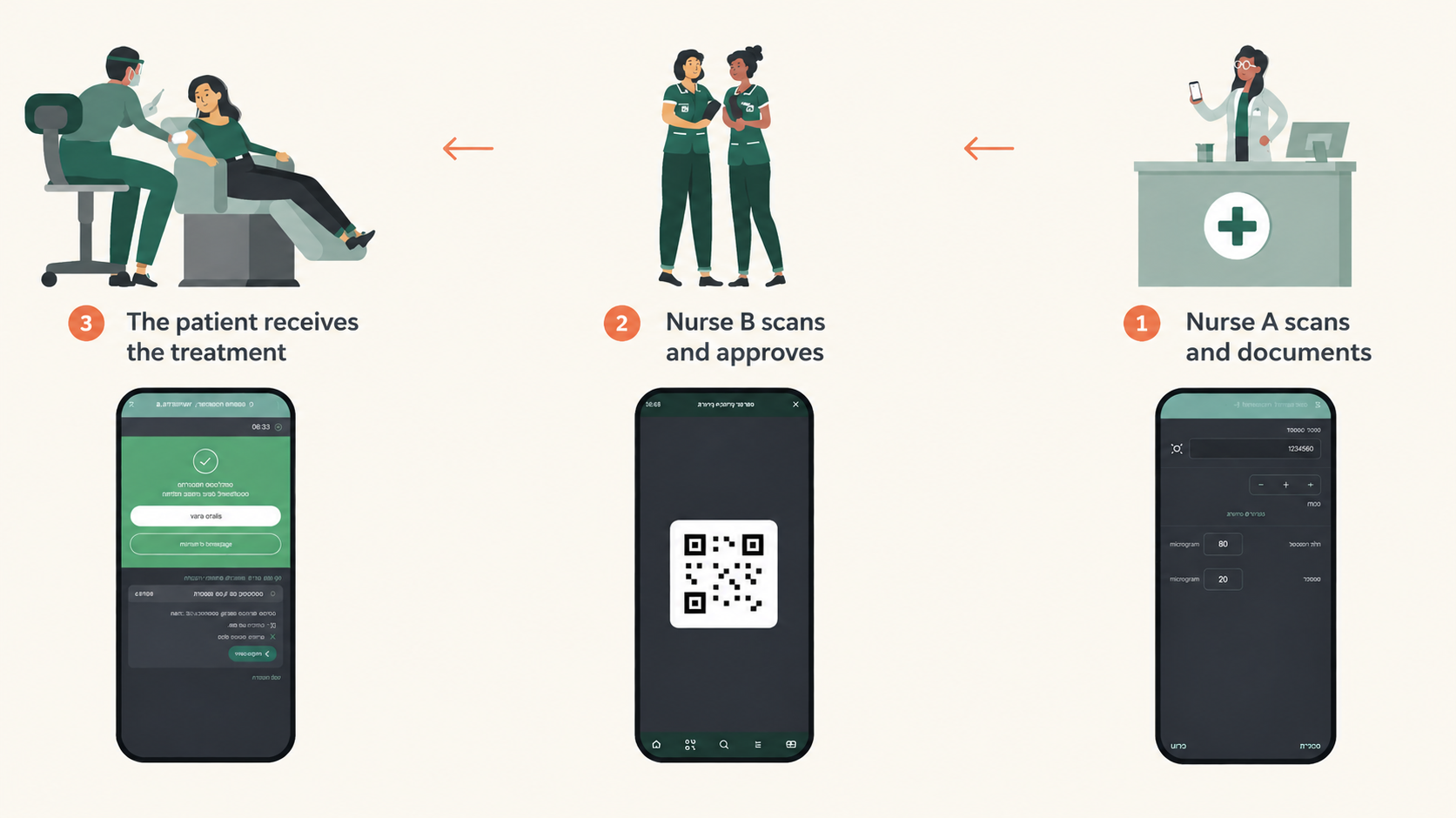
The Hospital as a Development Lab
Once the system had been implemented in several Israeli hospitals, it was clear that another local installation would not be enough. To show that the solution could also work in large, complex healthcare systems, it had to be tested in an environment with different procedures, regulations, and organizational culture.
That opportunity came through the Israel Innovation Authority’s International Collaboration program, which connected QLog with Manchester University Hospital in the NHS. The partnership offered an opportunity to test not only the system itself, but also the assumptions on which it was built.
“It was a real test,” says Dr. Lehavi. “When you manage to implement a system in a hospital of that scale, you know your solution is not suited to just one place. It can work elsewhere too.”
But the test went beyond proving that the system could function. Working with the teams in Manchester forced the company to reexamine processes that had seemed self-evident, adapt the system to new requirements, and refine it as the work progressed.
“We did not come to teach the hospital how to work. We learned quite a lot from them too,” Dr. Lehavi emphasizes.
The experience reinforced an insight that still guides the company today: hospitals are not only QLog’s customers but also partners in the development process. Each new healthcare system reveals different needs, and every implementation adds insights that continue to shape the product.
The lessons from Manchester continue to shape QLog’s work today. Every hospital that adopts the system adds another layer of knowledge. Work processes vary from country to country, and sometimes even between hospitals within the same healthcare system. Each implementation reveals new needs, which then feed back into further development.
“Every place like this makes us rethink things,” says Dr. Lehavi. “We come back with new insights, improve the system, and arrive better prepared at the next hospital.”
For this reason, Dr. Lehavi sees international collaboration as far more than a route to business expansion. Working with hospitals across different healthcare systems allows QLog to test the system under real-world conditions, learn from medical teams working in diverse environments, and continually improve it in response to needs that emerge in practice.
For QLog, this is also the path forward. As the system is implemented in more hospitals and more countries, it will continue to gain experience and improve. Ultimately, the goal is not only to make hospital operations more efficient, but to give medical teams more time to care for patients.
At a Glance: QLog
The
Mission
To develop systems that help hospitals manage equipment, processes, and resources, enabling medical teams to devote more time to treating patients.
The
Challenge
To prove that a system developed to meet the needs of Israeli hospitals is also suitable for large, complex healthcare systems worldwide.
The International Collaboration
Manchester University Hospital within the NHS, which tested the system under real-world conditions, provided field-based feedback, and contributed to its continued development.
The Role of the Innovation Authority
Through the International Collaboration program, the Israel Innovation Authority invested in the project. It established a connection with Manchester University Hospital, enabling the company to test and refine the system in a real-world working environment.
What Comes
Next?
To expand operations to additional hospitals worldwide and improve the system based on accumulated experience.

A Quote Worth Remembering
“We did not come to teach the hospital how to work. We learned quite a lot from them too.”
“In medical development, the path from a promising discovery to a product that reaches patients is long, costly, and high-risk. This is precisely where the Israel Innovation Authority has a role: investing where the market still hesitates, and enabling companies to build the evidence and experience needed to move forward. That is how scientific excellence becomes medical innovation with real impact.”
Dr. Alon Stopel, Chairman, Israel Innovation Authority