
Israel’s startup – Convergent, developed a new radiation measurement system in collaboration with a Singaporean company. Intuition Robotics adapted its social robot to Korean culture with the help of a local partner. Both collaborations in Asia opened the door to new markets
Before any radiation treatment, hospitals must make sure that the radiation will reach exactly the location intended by the physician. To do this, they use measurement systems to verify that the planned radiation dose is delivered to the right place and at the right intensity.
This is precisely the problem that Convergent R.N.R Ltd. set out to solve with an innovative system for targeted radiation therapy. Its technology makes it possible to focus X-rays more precisely, reduce the exposure of healthy tissue, and reduce the size of radiation delivery systems. But to ensure that treatment is actually delivered as planned, a new way of measuring the radiation itself was also needed.
“Every patient has a different treatment plan,” explains Eyal Glotman, Convergent’s Director of Development. “Before treatment begins, we need to make sure that the system will deliver the planned radiation dose exactly where it is supposed to go. That is why measurement and the tools needed to perform this task are an integral part of the treatment.”
But the measurement tools Convergent needed were not available on the market. At the same time, Singapore-based Enlipsium was looking for a different kind of partner.
“We come from the world of materials,” says Yzhar Perry, Founder and CEO of Enlipsium. “We needed someone who understood the equipment, the hospitals, and how radiation treatments need to be measured.”
The two companies, which had not previously known each other, were brought together by the Israel Innovation Authority’s International Division through SIIRD, the Singapore-Israel Industrial R&D Foundation. The fund provided the framework that turned an initial introduction into a joint development project, with each company contributing expertise the other lacked.
“Everything moved very quickly,” Perry recalls. “We started talking in the summer, submitted the application in September, and by the end of December we had received approval and started working.” But for Perry, the timeline was only part of the story. “We weren’t looking for another materials expert,” he says. “We were looking for expertise we didn’t have.”
Each Brought What the Other Lacked
Enlipsium knew how to develop advanced materials, but it had never built medical measurement devices or worked in hospitals. Convergent, on the other hand, knew the clinical environment well but was looking for a new way to measure the focused radiation it had developed.
A measurement system alone was not enough. They also needed a material capable of absorbing X-rays and recording their distribution with high sensitivity, so that it could later be measured accurately. The material developed by Enlipsium is based on specialized nanocrystals that store energy from X-rays. After exposure, the film containing the nanocrystals is heated, releasing the stored energy as light. The intensity of the light makes it possible to calculate with high accuracy the radiation dose received at each point, while allowing the same film to be reused countless times.
Glotman explains how the work was divided between the two companies: “Enlipsium brought the material, and we brought our knowledge of radiation systems and the needs of hospitals.”
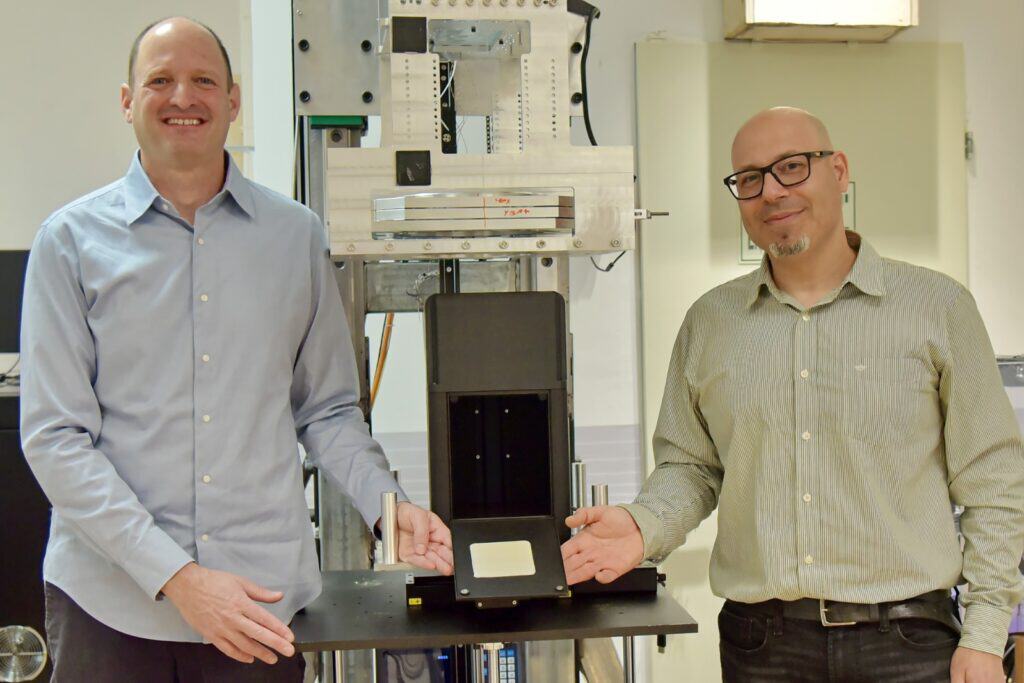
Based on this division of expertise, the two companies developed a dedicated device that combines Enlipsium’s film with a heat source and a high-resolution optical imaging system. Within minutes, it produces a detailed map of the radiation distribution, making it possible to verify that the treatment will be delivered exactly as planned.
“The tool is used by the medical physicist,” Glotman explains. “It is their responsibility to make sure that each patient receives the radiation dose planned for them. The more accurate the measurement tool, the greater the confidence that the treatment will be delivered as planned and that unnecessary harm will be avoided.”
Another advantage is that the film can be reused, unlike the films commonly used today, which are disposable and significantly more expensive.
For Perry, however, the project’s most important achievement is not the product each company brought to the collaboration, but what they created together. “Each of us has a unique technology,” he says. “But there is also what we developed together.” In his view, it was precisely the combination of these two fields of expertise that turned a good idea into a system that could move beyond the laboratory and be put in front of real users.
With the measurement system developed through the collaboration between Convergent R.N.R and Enlipsium. Right: Eyal Glotman; left: Yzhar Perry.
The Real Test Began Outside the Lab
The system’s real test began when it left the laboratory and was put to use in hospitals. Until then, both companies knew that it worked under laboratory conditions. Now they wanted to understand how it would perform in the working environment of the professionals expected to use it every day.
As part of the project, the system was tested in Israel and Singapore using advanced radiation systems and under real-world working conditions. For both companies, this was an opportunity to evaluate not only the system’s performance, but also how medical physicists worked with it, what data they needed to see, and how it could be integrated into their daily routines.
“The medical physicist started working with the system the very day we brought it into the hospital in Singapore,” Perry recalls. “By midnight, he was already sending me messages about the experiments he had conducted. He was as excited as a child with a new toy. For me, that feedback was just as important as any laboratory experiment because, ultimately, if the people who are supposed to work with the system don’t adopt it, as happens in quite a few cases, it wont matter how good the technology is.”
Glotman also emphasizes that the system’s success is measured not only by its performance, but also by users’ willingness to adopt it. “Medical physicists are a very demanding audience,” he says. “If they don’t trust the measurement, they simply won’t use the system.”
The feedback from the hospitals did not wait until the end of the project. It became part of the development process itself. The two companies continued to refine the system, make adjustments, and improve it while working with users. In this way, both the technology and the confidence that it could be implemented in a clinical environment advanced in parallel.
At the end of the conversation, Perry wanted to add one more point. “We wouldn’t have done this without the Israel Innovation Authority. The International Division created the framework that enabled two companies, each an expert in its own field, to work together, learn from one another, and turn complementary expertise into a single product.”
At a Glance: Convergent R.N.R – Enlipsium

The Mission
To develop a fast, accurate radiation dose measurement system that helps ensure radiation treatments are delivered exactly as planned.

The Challenge
To combine expertise in advanced materials with in-depth knowledge of radiation systems and the clinical environment and turn that combination into a working product.

The International Collaboration
The collaboration between Israel-based Convergent and Singapore-based Enlipsium through the SIIRD Foundation. Each company brought expertise the other lacked, and together they developed a new radiation measurement system.

The Role of the Israel Innovation Authority
The International Division and the SIIRD Foundation provided the framework that turned the connection between the two companies into a bilateral development project, tested in Israel and Singapore.

What Comes Next?
To integrate the measurement system into Convergent’s radiation systems, expand its use to additional radiation systems, and advance the commercialization and regulatory processes required for use in hospitals worldwide.

A Quote Worth Remembering
“We wouldn’t have done this without the Israel Innovation Authority.”
“For Israeli companies, international collaboration is not only a way to develop technology, but a way to get familiarized with a new market from within. The local partner brings knowledge of the culture, customers, and business environment; the Israeli company brings innovation and technological capability. That combination creates not just a better product, but proof of capability and a reference that can open doors to further markets.”
Shlomi Kofman, VP & Head of International Collaborations Division
Manners Are Part of the Code
A robot that can talk, recognize faces, and carry on a conversation, can still fail at one seemingly simple task: understanding the person in front of it.
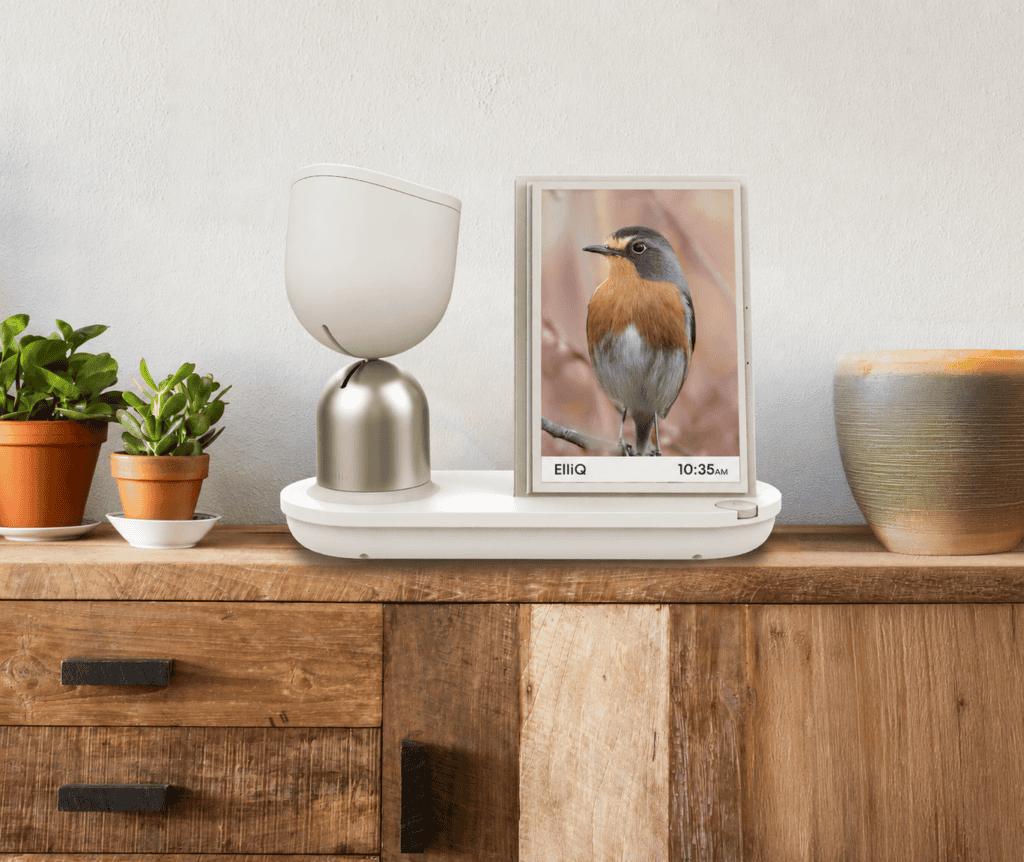
For Intuition Robotics, developer of the social robot ElliQ, understanding the person she interacts with was anything but a theoretical question. ElliQ was designed to help older adults live more active, independent, and connected lives. She talks with users, suggests games and activities, reminds them to take their medication, and helps them stay in touch with family members. She gets to know the person she interacts with, remembers details from previous conversations, and initiates interactions based on their habits and interests.
Behind the friendly, approachable character is a complex artificial intelligence system designed to create natural communication and a sense of connection without pretending to be human. “The robot constantly reminds users that she’s not a person,” explains Michael Kupferman, the company’s VP of R&D. “That’s actually what allows people to feel comfortable with her.”
But as the company moved into international markets, it became clear that the challenge went far beyond translating the language. For users to feel comfortable talking to a robot, speaking their language is not enough. The robot also needs to understand habits, cultural codes, and patterns of communication that vary from country to country.
Intuition Robotics realized that this kind of knowledge was difficult to develop from afar. To adapt ElliQ for users in Korea, the company needed a partner with a deep understanding of the local culture, its users, and their everyday lives.
It found that partner in SK Telecom, one of South Korea’s largest telecommunications companies, through the KORIL-RDF fund, one of the International Division’s international collaboration programs at the Israel Innovation Authority. Intuition Robotics brought its expertise in developing an AI-powered social robot, while SK Telecom brought its deep knowledge of the Korean market and its expertise in hardware and robotics.
Even a Robot Needs to Know When to Stay Silent
The engineering changes were only one part of what the two companies learned together. As the work with the Korean team progressed, it became clear that the way ElliQ communicates with users could not remain the same everywhere. A social robot is judged not only by what it knows how to say, but also by how it addresses the person in front of it, when it chooses to start a conversation, and even when it chooses to say nothing at all.
The differences touched almost every aspect of the interaction: when ElliQ initiates a conversation, how many times she suggests an activity before giving up, what users find funny, and what kind of approach might feel intrusive. What works well in the United States does not necessarily work for users in Korea or Japan.
“In Japanese, you can’t simply address someone directly the way we do in English,” Kupferman explains. “Sometimes you need to hint at something, show something on the screen, or find a more indirect way to start a conversation. These are cultural differences, but they have a direct impact on the user experience.”
Even one of the most basic elements of communication, eye contact, became a subject of research. One experiment conducted as part of the project examined how users responded when the robot returned their gaze after detecting that they were looking at it. Kupferman says that this seemingly simple experiment later became an important reference point for the company in conversations with international customers and partners.
Working with the Korean partners made a cultural adaptation part of the development process itself. The two teams studied user behavior together, developed ideas, tested them, and refined the product throughout the development process.
“At the end of the day,” says Kupferman, “you’re not developing technology for a particular country. You’re learning how to build technology that respects the people who use it.”
One Partnership Leads to the Next
For Kupferman, a project with a major international partner offers another kind of value, one that continues long after the development teams have completed the task they set out to accomplish.
“We use all the work we do with the support of the Israel Innovation Authority as a reference,” he says. “When you can say that you’ve demonstrated in an experiment, together with academia and a Korean partner, that people respond differently to a robot that looks at them and returns their gaze, that’s a great reference.”
Being able to present results tested as part of a joint project has helped Intuition Robotics open doors in other markets as well. Kupferman points, among other examples, to New York State, where ElliQ is already being used through a collaboration with the New York State Office for the Aging.
“Now that we’re entering Japan, there’s no question that when they hear Korea, something clicks,” he says. “It gave our entire move into Asia a real boost.”
Alongside SK Telecom, the project had another important partner: academia. Two academic studies were conducted as part of the project, adding to the company’s previous collaborations with Reichman University, Bar-Ilan University, and other research institutions. For Kupferman, this connection between industry and academia is one of the important advantages of the Israel Innovation Authority’s programs.
“They ‘forced’ us, in quotation marks, to collaborate with academia,” he says. “Industry and academia benefit from each other. In these projects, we conducted laboratory experiments in psychology and computer science, and we’re still working with those partners. It contributed enormously.”
The studies allowed the company to explore questions that are difficult for a development team alone to answer: Does eye contact change how users respond? Does trust between a person and a robot develop over time? Which gestures create a sense of connection? The findings did not remain confined to academic papers. They made their way into the product and, in some cases, also became evidence the company could present to its next customer.
That is the difference between a grant and a project that continues to create value. The funding makes development possible. The framework brings together an Israeli company, an international partner, and academia, allowing them to test ideas together and produce results that the company can take with it into its next market.
ElliQ is already moving into its next stage. The company is expanding its activities in the U.S. healthcare sector and exploring additional markets in Asia. The robot, originally created to help alleviate loneliness among older adults, continues to expand into new markets as the technology is adapted to new cultures and users.
At a Glance: Intuition Robotics – SK Telecom
The Mission
To adapt an AI-powered social robot for users from a different culture, while developing a product that is simpler, more efficient, and less expensive to manufacture.
The Challenge
To enable ElliQ to understand not only a new language, but also different cultural codes and communication patterns, while combining the complementary capabilities of the two companies.
The International Collaboration
The collaboration between Intuition Robotics and SK Telecom through the KORIL-RDF fund, which led to changes in the product architecture, cultural adaptations, and studies examining how people respond to a social robot.
The Role of the Israel Innovation Authority
The International Division and the KORIL-RDF fund provided the framework for the joint development project, encouraged collaboration with academia, and enabled the company to build knowledge and references that helped open doors in additional markets.
What Comes Next?
To expand ElliQ’s activities in the U.S. healthcare sector and continue entering markets in Asia, while adapting the technology to new cultures and users.
A Quote Worth Remembering
“Each of us came away with a better product than we could have developed alone.”