
In space, there are no second chances. Two Israeli companies discovered how collaboration with Space Florida can cut years off development, connect with world-class partners, and carry their technologies to U.S. transportation agencies and NASA
For technology to make its way into space, a good idea is not enough. It has to prove itself again and again, with partners, under real-world conditions, and in environments that cannot be replicated on Earth.
For StemRad, that path has included a collaboration with U.S. aerospace and defense company Lockheed Martin through the Israel Innovation Authority’s Space Florida program. The partnership brought together the Israeli company and one of the world’s largest aerospace companies, taking StemRad’s technology from applications designed to protect emergency and rescue personnel during nuclear incidents to testing on NASA space missions.
The idea that eventually became StemRad began to take shape while Dr. Oren Milstein was studying at the Weizmann Institute of Science. Still, it gained momentum after the Fukushima disaster in 2011 highlighted the need for personal protection against ionizing radiation. The company was founded to develop a solution that selectively protects the body’s most vulnerable organs without burdening the wearer with unnecessary weight and bulk.
The turning point came when StemRad connected with Lockheed Martin through the Israel Innovation Authority’s Space Florida program. At the time, the U.S. company was developing the Orion spacecraft for NASA’s return to the Moon and was looking for a way to protect astronauts from radiation during extended space missions. For StemRad, it was a chance to determine whether technology developed for Earth could also address one of the most complex challenges of spaceflight.
“The Israel Innovation Authority’s investment was reflected not only in the funding, but also, and above all, in creating the connection with the other side,” says Dr. Milstein. “Space Florida created an atmosphere of trust and friendship between us and the managers and engineers at Lockheed Martin. We were a small company from Israel with ambitions to do something big in space. That trust was especially important in the early days.”
Within about two years, the development team had its first prototype: a radiation protection vest for use in space. It was tested inside an Orion spacecraft at NASA’s Johnson Space Center. The prototype was later tested in a series of experiments aboard the International Space Station and on Artemis I, which launched in late 2022 and orbited the Moon as part of NASA’s human lunar exploration program.
“Engineering is always a compromise,” says Dr. Milstein. “On the one hand, we wanted to maximize protection. On the other, it was clear that if the astronaut couldn’t work comfortably, we hadn’t achieved anything.” The insights gained from the initial tests led to further improvements. In the next stage of the project, experiments aboard the International Space Station enabled examination of how the vest performed in microgravity and over time, and continued refinement of the design for future missions.
Two Mannequins, One Experiment
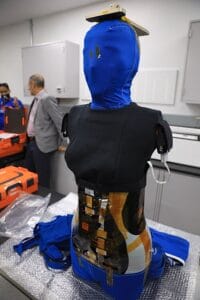
On NASA’s Artemis I mission, which tested systems that will be used on future crewed missions to the Moon, two identical anthropomorphic mannequins were sent into space. One, Zohar, wore the vest developed by StemRad. The other, Helga, had no protective gear. Both mannequins contained thousands of sensors that recorded radiation levels in different organs throughout the journey around the Moon.Comparing the two allowed researchers, for the first time, to assess the vest’s contribution under actual space conditions.
“We had high expectations, but the results were even better than we expected,” says Dr. Milstein. According to the data analysis, in the event of a significant solar storm, the vest could reduce an astronaut’s effective radiation dose by approximately 60%, even though it does not cover the entire body; instead, it focuses on the organs most vulnerable to radiation.
The knowledge gained from the process was just as important as the actual results. The data from Artemis I, combined with earlier findings from the International Space Station, allowed the team to continue improving the product. “Ultimately,” says Dr. Milstein, “you have to find the balance between maximum protection and comfort. If the astronaut cannot perform the mission, even the best protective gear will not achieve its purpose.”
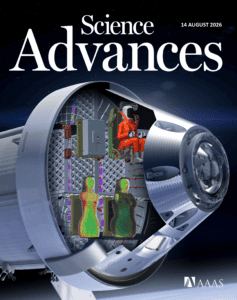
Right: The MARE experiment aboard Artemis I examined radiation exposure in space and the effectiveness of StemRad’s AstroRad radiation protection vest. The results were published in August 2026 as a cover article in Science Advances.
Left: Preparations for the MARE experiment ahead of the Artemis I mission. The manikins Helga and Zohar were equipped with radiation detectors, with Zohar also wearing the AstroRad radiation protection vest. Photo: NASA/Ben Smegelsky
If You Believe, Your Partners Will Too
The path to NASA’s space missions was not paved by engineering innovation alone. For a young Israeli company to work with one of the world’s largest aerospace companies, it also had to build trust.
“When a small company from Israel wants to convince a company like Lockheed Martin to work with it, it has to truly believe in what it is doing,” says Dr. Milstein. “If you believe, your partners will too.”
The Israel Innovation Authority’s Space Florida program provided the framework that allowed the two sides to work together over time, test ideas under real-world conditions, and turn a professional relationship into an ongoing collaboration.
StemRad’s journey is not over. The next goal is to reduce the vest’s weight by using components that can be printed or assembled from materials already available aboard the spacecraft, eliminating the need to launch them from Earth. This project is also being carried out through the Israel Innovation Authority’s Space Florida program, in collaboration with Redwire, to continue improving the system for future space missions.
At a Glance: StemRad

The Mission
To develop personal protection against ionizing radiation that provides maximum protection without adding unnecessary weight or bulk for the wearer

The Challenge
To adapt radiation protection technology originally developed for emergency and rescue personnel to the demanding requirements of extended space missions.

The International Collaboration
The collaboration with Lockheed Martin through the Space Florida program enabled testing of the technology under actual space conditions and its adaptation for NASA missions.

The Role of the Israel Innovation Authority
The Israel Innovation Authority established the initial connection with Lockheed Martin, supported the project through the Space Florida program, and accompanied the collaboration throughout its development.

What Comes Next?
To develop the next generation of radiation protection for space, including solutions that reduce the system’s weight and incorporate components that can be printed or assembled during the mission.

A Quote Worth Remembering
“The Israel Innovation Authority helped us not only with funding, but also, and above all, by connecting us with the other side.”
Partnerships are not built around a single project. The collaboration between the Israel Innovation Authority and Space Florida has continued uninterrupted since 2013, providing Israeli and American companies with an established framework for jointly developing technologies, sharing risks, and advancing toward commercialization. Over the years, the collaboration has evolved from a funding platform into an innovation ecosystem.
An Israeli Platform Changes How Traffic Is Managed in the United States
Some technologies are demonstrated in a presentation, and others can be proven in a laboratory. But when developing systems designed to manage public infrastructure, neither is enough.
Transportation authorities do not buy ideas. They want to see how a system handles real traffic congestion, integrates into their workflows, and helps them make decisions in real time. For them, the difference between a promising technology and one that can actually be deployed almost always comes down to a proven track record.
Dov Ganor knows this reality well. As CEO of Mobility Insight, he leads a company that has developed a transportation management platform built around data from a wide range of sources. Rather than allowing each system to operate independently, the platform integrates data from connected vehicles, cameras, sensors, and other sources. It integrates all this data sinto a single picture that shows not only what is happening now, but also identifies events that could develop within minutes into significant traffic congestion and affect large areas of a city.
Such technology cannot be validated in a conference room. “Our customers are governments and transportation authorities,” says Ganor. “They can’t afford to take risks. They need to see that the system works, that it can handle real-life situations, and that they can rely on it.”
For Mobility Insight, the Israel Innovation Authority’s Space Florida program was far more than a support program. It was through the program that the company connected with SRF Consulting Group, its direct U.S. partner on the project. Together, they developed a Transportation Management-as-a-Service (TMaaS) pilot in Central Florida. Space Florida and the Israel Innovation Authority provided the framework, funding, and connection that allowed the partnership to get underway.
In the world of public infrastructure, a technology company cannot demonstrate a system without a contractual framework with a government entity. This creates a significant barrier to entry that is extremely difficult to overcome independently. The Israel Innovation Authority addressed precisely this barrier, providing something akin to winning a government tender: the framework and credibility needed to work with U.S. transportation agencies.
This allowed Mobility Insight to work directly with those agencies, test its system under real-world conditions, receive feedback from the customers it was designed for, and demonstrate its ability to integrate with existing infrastructure.
It also marked a turning point for the business. Instead of presenting a vision, Mobility Insight could point to experience. Instead of promising that its system could integrate with traffic management centers, the company could demonstrate its performance in an operational environment. In a sector where public infrastructure operators adopt new technologies with considerable caution, that is the difference between a good idea and a product that begins to open doors.
The pilot was designed to address a unique transportation challenge in Florida’s Space Coast region. The system combines information from cameras and traffic sensors with additional data, including launch schedules from Kennedy Space Center, to predict the congestion these launches could create and suggest ways to respond before the roads become clogged. Following a successful trial phase, the project received additional funding and is moving toward operational deployment in collaboration with the Florida Department of Transportation District 5 (FDOT District 5) and Brevard County.
The World No Longer Manages Intersections, but Networks
For years, cities have tried to solve transportation problems locally. They added a lane, retimed a traffic light, installed another camera, or added another sensor. But as cities became more crowded and transportation systems more complex, it became clear that the challenge no longer lies in individualintersections, but in how every part of the network affects the others.
“If you walk into a traffic management center today, you’ll see hundreds, sometimes even a thousand cameras,” says Ganor. “You can’t watch a thousand cameras. No human being can see everything, understand everything, and make timely decisions.”
That realization also shaped Mobility Insight’s approach. Rather than adding more sources of information, the company aims to turn existing information into knowledge that can be acted upon.
The implications go far beyond managing traffic jams. A crash, roadwork, or a large-scale event no longer affects only the street where it occurs. Its impact can spread across the entire transportation network. Decision-making therefore must change accordingly.
“The best solution is a vehicle that never reaches the intersection,” says Ganor. “Whenever possible, it’s better to prevent congestion before it happens, rather than just react to it.”
Mobility Insight’s system in action, analyzing traffic and infrastructure data in real time.

But this approach cannot be proven in a presentation either. It has to operate in an environment where every decision is tested against reality, alongside the professionals responsible for transportation infrastructure and against the everyday challenges of a functioning city.
The collaboration through the Israel Innovation Authority’s Space Florida program allowed Mobility Insight to do exactly that. The pilot did more than test the system’s performance. It allowed the company to work alongside its future customers, understand their needs, refine the product, and demonstrate its ability to integrate into existing workflows.
For Ganor, this is the real value of international collaboration. It does not end with developing the technology. It provides the conditions needed to turn a new technology into a practical tool that decision-makers are willing to adopt.
At a Glance: Mobility Insight
The Mission
To help transportation authorities manage road networks in real time by combining data from multiple sources and turning them into insights that support decision-making.
The Challenge
To prove that the system can integrate with existing transportation infrastructure, respond to events in real time, and earn the trust of public-sector transportation agencies.
The International Collaboration
The collaboration with Space Florida enabled the company to test its technology in an operational environment in the United States, work with transportation agencies and potential customers, and demonstrate its capabilities under real-world conditions.
The Role of the Israel Innovation Authority
The Israel Innovation Authority connected the company with the Space Florida program, opened doors to the U.S. transportation ecosystem, and enabled it to test its technology in collaboration with local partners.
What Comes Next?
To expand the company’s operations in the United States, deepen its collaborations with transportation agencies, and continue developing tools for predictive management of transportation networks.
A Quote Worth Remembering
“You can’t watch a thousand cameras. No human being can see everything, understand everything, and make timely.”
“Space-bound technologies must be tested and validated under the most demanding conditions, yet young companies rarely have access to the infrastructure and partners required. The collaboration with Space Florida bridges that gap: Israeli companies can prove their technology alongside leading organizations and turn local innovation into capability with global impact.”
Dr. Alon Stopel, Chairman, Israel Innovation Authority