Appendix 1: Innovation Authority Activity in 2025
The Israel Innovation Authority endeavors to provide a solution to the different challenges facing the Israeli innovation hub via three operative units that engage in investment and removal of barriers, called “divisions”. Each division is mission-oriented and offers a unique toolbox that is adapted to the various challenges in the technological lifecycle.
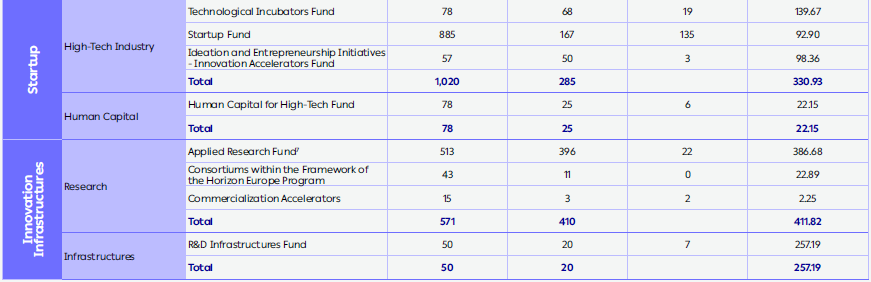
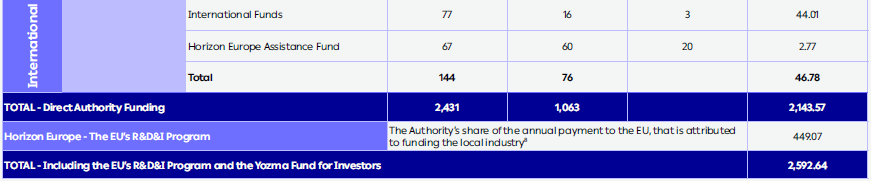
The Innovation Authority’s divisions undertook a variety of initiatives during 2025 with the aim of advancing the competitiveness and growth of the Israeli innovation hub. The table below details the different divisions’ activity last year, according to the funds/programs they operate:¹
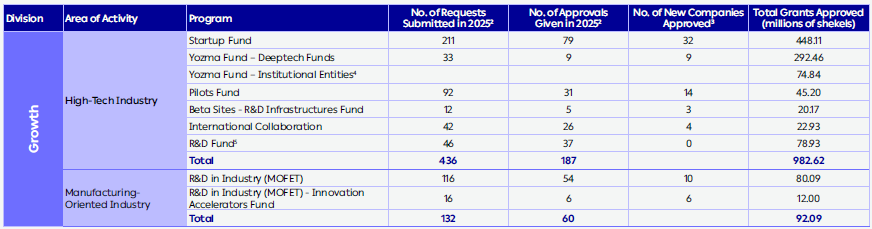
- Descriptions of the different funds and programs appear on the Innovation Authority website and in previous reports published by the Authority.
- In most cases, 8-12 weeks elapse between the time a request is submitted and the time it is brought to the committee for approval. Accordingly, the figures for approvals in 2025 also include requests submitted at the end of 2024, and some of the submissions for 2025 (those submitted at the end of the year) were discussed by committees in 2026.
- The requests and approvals are presented according to the files submitted. Some companies have several submissions and even several approvals in the same program or in several programs. Accordingly, companies that first received investments from the Authority in 2025 and which received more than one investment in the same program, are counted once under the definition “new companies in the same program”. Companies that first received investments from the Authority in 2025 in two different programs, are counted in each of the programs as “new companies”. Accordingly, a total of 290 new companies were approved in 2025.
- As part of the Yozma 2.0 Fund, the Authority provides 23% of the total investment framework in Israeli venture capital funds by the institutional investors who applied to the program. The initial approval for the institutional investors’ requests was granted in 2024. The investment framework of each institutional investor was approved in USD at an exchange rate of NIS 3.766 (which was the exchange rate at the time the original requests were approved). In 2025, increases were approved to the Authority’s participation framework in the institutional investors’ investments of a total of approximately USD 19.63 million (NIS 73.92 million). Accordingly, the Authority’s total investment framework stands at approximately USD 140.37 million (NIS 528.66 million). An additional NIS 0.92 million was approved to enhance institutional entities’ capabilities of identifying and analyzing investments in Israeli high-tech companies.
- 2025 was the R&D Fund’s final year of operation.
- In some of the programs for ideation, entrepreneurship, and investment initiatives, there are initiatives in which a franchisee is chosen to run the initiative for several years. During each year of the franchise, the franchisee is required to submit a yearly work plan before investment approval.
- The Applied Research Fund includes the following programs – MAGNET consortiums, Applied Research in Industry, and Applied Research in Academia.
- The Authority pools resources from the participating government entities – the Committee for Budget and Planning, the Ministry of Innovation, Science and Technology, and the Innovation Authority – and transfers Israel’s annual participation payment to the EU. The total participation payment in 2025 was NIS 1,123 million, approximately EUR 282.5 million.
Appendix 2: Authority Investments Are Focused on Fields With Low Availability of Private Capital
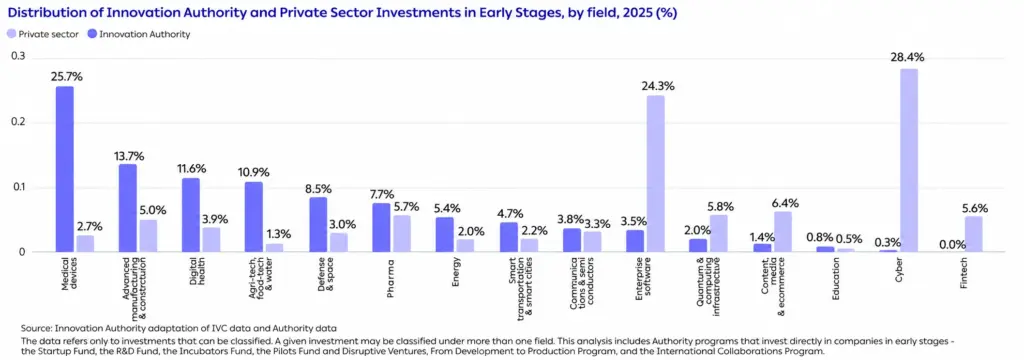
The Innovation Authority’s investments in Israeli technology companies focus on fields with a higher likelihood of market failure and with funding gaps in early growth stages. The distribution of investments by field reflects the Authority’s policy of operating in areas with relatively low availability of private capital.
The fields of medical devices, advanced manufacturing, and digital health account for approximately 51% of all Innovation Authority early-stage investments, while their share of private capital investments is only about 12%. The fields of agri-tech, food-tech and water also account for about 11% of the Authority’s investments, compared with only about 1% of private capital investments.
By contrast, in fields where private capital is more readily available, such as cyber, enterprise software and fintech, the Israel Innovation Authority’s share is relatively low. For example, cyber accounts for about 28% of private capital investments in early stages, while its share of Innovation Authority investments is less than 1%.
This distribution reflects the Israel Innovation Authority’s policy of focusing on and investing in fields with high technological risk, long development times and significant commercialization challenges, where raising capital in early stages is relatively more difficult. This is intended to reduce risk for private investors and encourage their activity in these fields as well.
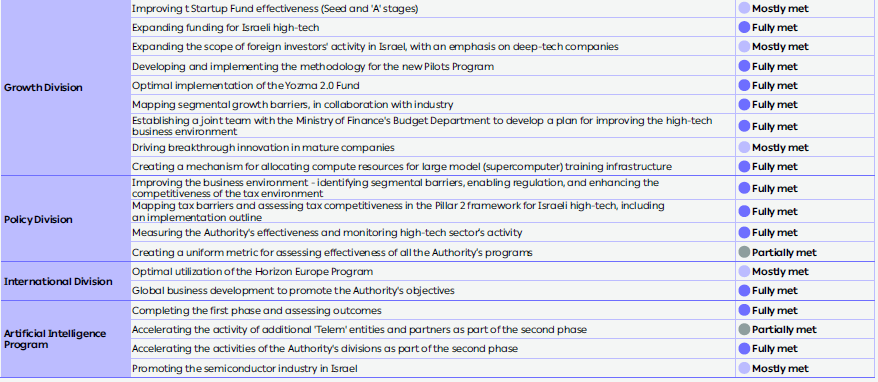
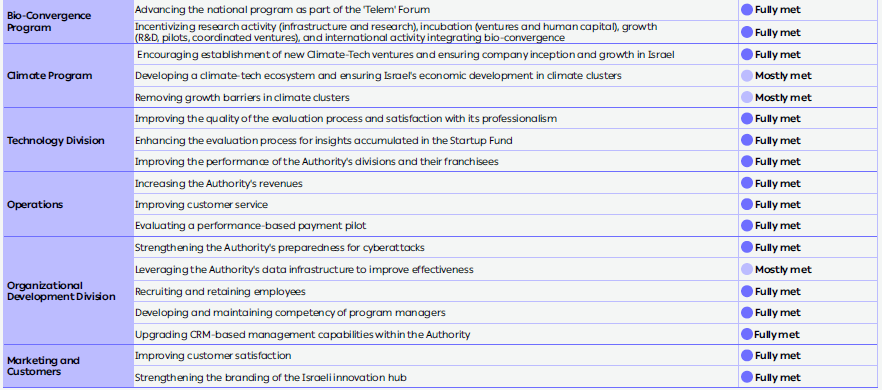
Appendix 3: Status of 2025 Work Plan
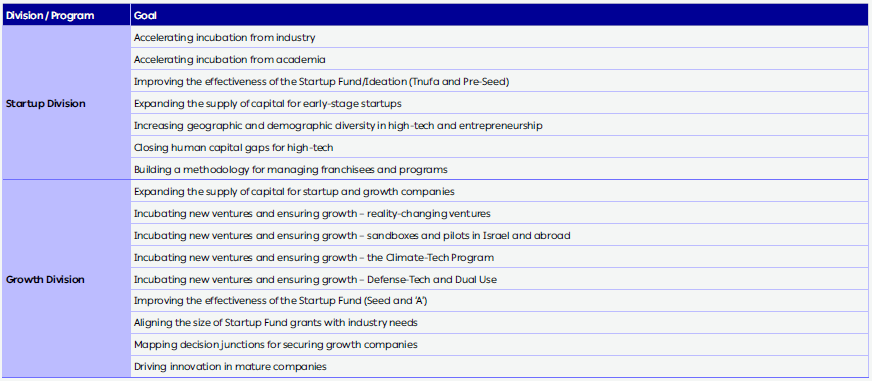
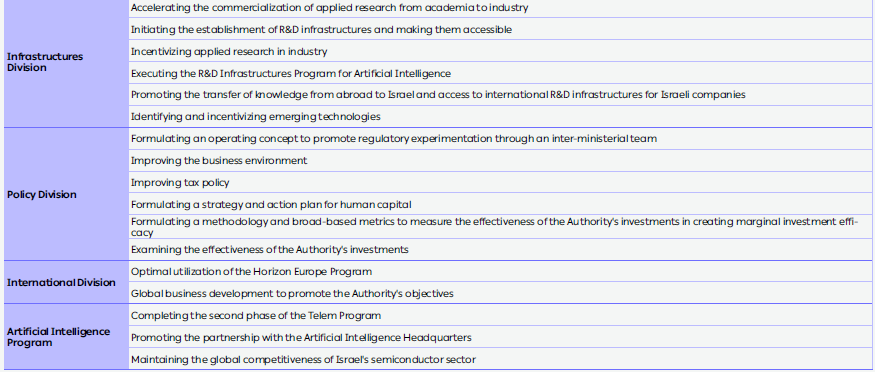
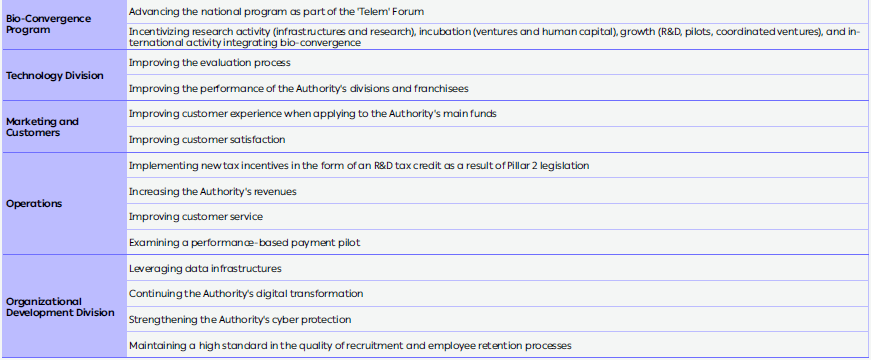
Appendix 4: Work Plans in 2026
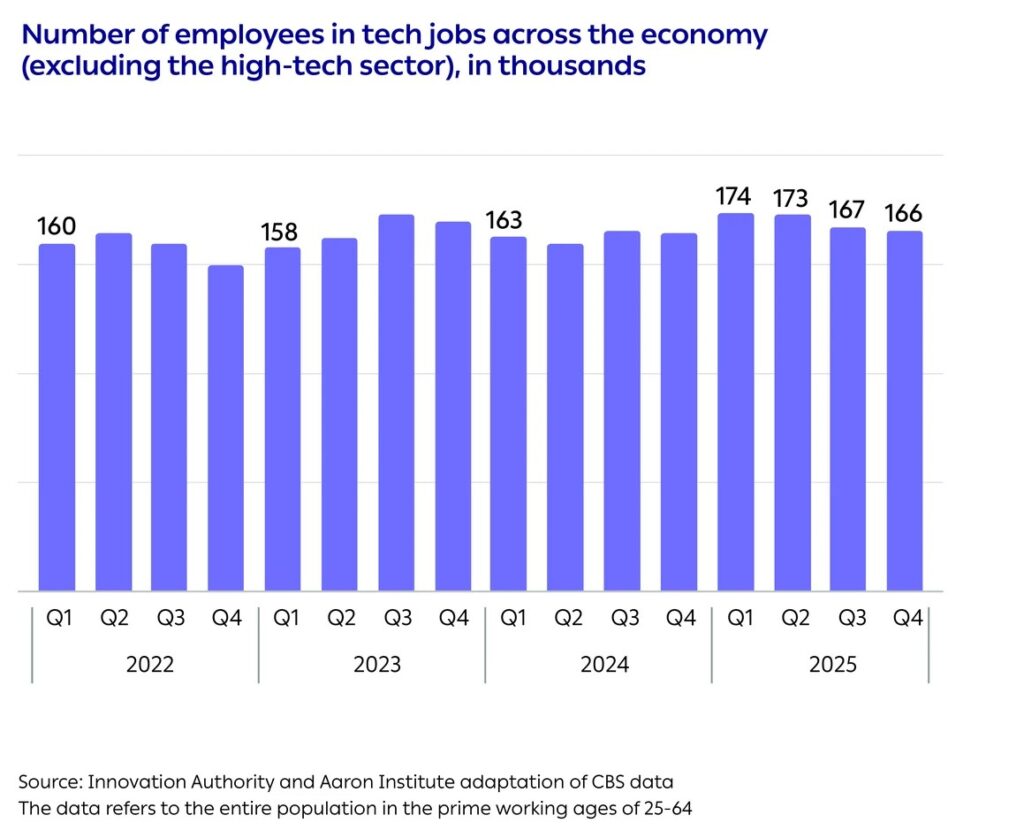
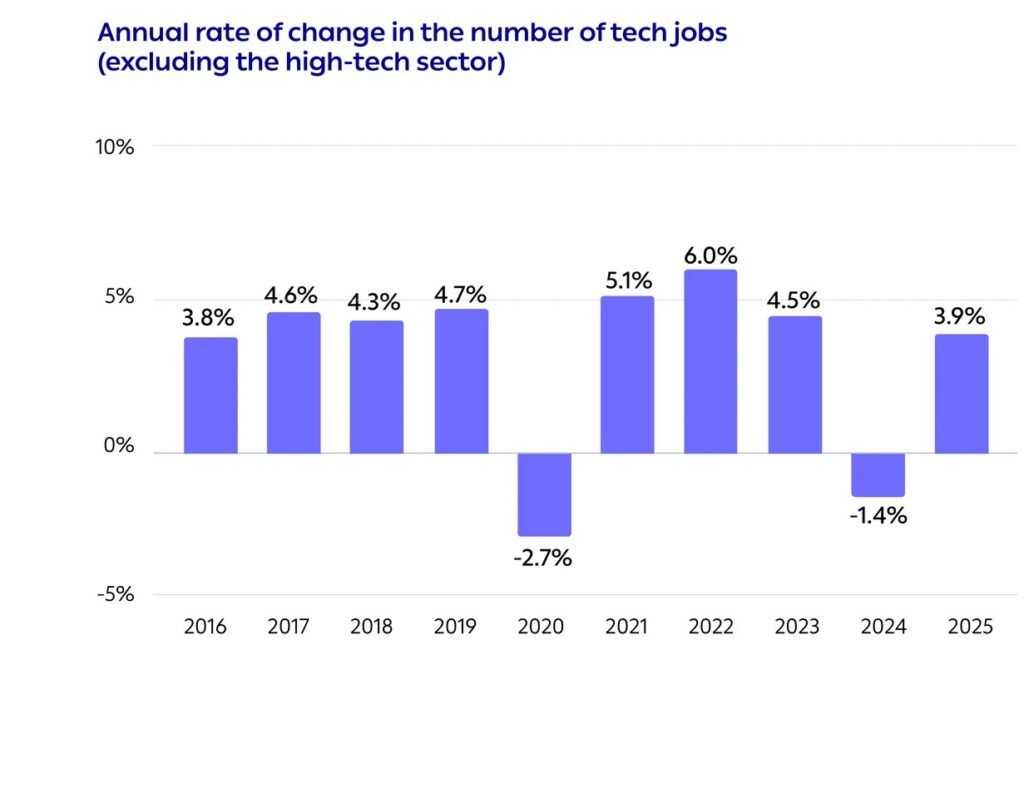
Appendix 5: Employment in Tech Jobs Across the Economy