
Enzymit reversed the logic of biomanufacturing. Instead of adapting what living cells can produce, it designs cell-free enzyme systems from the bottom up for a desired industrial outcome. Immunai reversed the direction of medical research, from a single experiment to a complete model. The World Economic Forum opened the doors to the right markets for both companies
Is it possible to produce nearly every material humanity needs without relying on farmland, complex chemical processes, or manufacturing methods that have remained largely unchanged for decades? That is the question driving Gideon Lapidoth, Founder and CEO of Enzymit. The company is not developing a single product or solving a single problem. It is building a new production platform designed to manufacture a wide range of materials and chemicals with precision, efficiency, and flexibility. As the platform scales, it could change not only how specific products are made, but how entire industries think about manufacturing.
“There are enough raw materials to meet humanity’s needs,” says Lapidoth. “The challenge is to build the machine that can turn them into what we actually need.” In his view, global shortages of food, raw materials, and essential products do not necessarily stem from a lack of resources. Rather, they reflect the limitations of today’s manufacturing technologies. The real challenge, he explains, is not finding more raw materials but developing a more efficient and flexible way to use those already available. By enabling essential materials to be produced closer to where they are needed, this technology could give countries and regions greater supply independence.
Enzymit has already demonstrated that the science works. The focus now is commercialization: scaling the technology, integrating it with existing manufacturing processes, and meeting industry requirements. This means deploying the solution under real-world production conditions, refining the process, and building the customer confidence required to establish a global industrial platform.
Enzymit’s cell-free platform uses engineered enzymes to create new manufacturing pathways.
Biology Becomes a Manufacturing Platform
For decades, the biotechnology industry has relied on the principle that if you want to produce a biological material, you recruit a living cell to do the job. Bacteria, yeast, or other cells carry out the process while researchers try to steer them toward the desired outcome. That approach has enabled countless breakthroughs, but it also limits the ability to control the process, improve efficiency, and adapt it to new needs.
Enzymit flips the perspective. Instead of relying on the entire living cell, it works only with enzymes, the proteins that drive the chemical reactions inside the cell. Each enzyme is engineered to perform a single, specific function, and together they form an entirely new production pathway, designed around industrial needs rather than the nature’s solutions that evolved over millions of years.
“If we can design an enzyme to perform exactly the reaction we need, we can build an entirely new manufacturing process,” says Lapidoth. “Not one that imitates nature, but one designed for the needs of industry.”
Enzymit’s vision, however, extends far beyond a single product. The company’s goal is not simply to produce hyaluronic acid, or any other material, more effectively. It aims to build a platform that will eventually become an entirely new production system for a broad range of materials.
To achieve that goal, the company did not begin with low-cost products manufactured at massive scale. Instead, it chose to validate the technology using a high-value product, i.e, hyaluronic acid. If it could be produced through an efficient and precise enzymatic process, the same approach could then be applied to many other products.
Even this idea had to wait for the science to catch up. Only advances in protein engineering, computational capabilities, and artificial intelligence have made it possible to design enzymes with a level of precision that was previously unattainable.
“Just a few years ago, we simply did not have the tools to do this,” says Lapidoth. “Today, we can design enzymes that are more stable, more precise, and better suited to specific manufacturing tasks.”
The collaboration with Cosun was an important step in this transition. It enabled Enzymit to demonstrate the platform beyond the laboratory, using industrial manufacturing infrastructure and operating at a scale relevant to industry. That validation created the foundation for commercial deployment.
At a Glance: Enzymit

The Mission
To build a cell-free manufacturing platform that will change the way industry produces biological materials.

The Challenge
To commercialize a precise, efficient, and scalable enzymatic production platform as an alternative to cell-based manufacturing.

The International Collaboration
The collaboration with the Dutch company Cosun, which made it possible to demonstrate the technology in a real industrial production environment.

The Role of the Israel Innovation Authority
The Israel Innovation Authority facilitated the connection through its International Collaboration programs. It later opened doors for the company to participate in the World Economic Forum’s Technology Pioneers community and in C4IR Israel.

What Comes Next?
To commercialize the platform for hyaluronic acid and expand it to additional materials.

A Quote Worth Remembering
“I want Enzymit to become the Dow Chemical of the 21st century.”
The Israel Innovation Authority connects Israeli companies with additional markets and decision-making arenas where the future of technology is shaped. Through C4IR Israel and its work with the World Economic Forum, companies can participate in international discussions and initiatives, meet with corporations and policymakers, and bring Israeli expertise to the tables where standards, regulations, and solutions to global challenges are shaped.
Can a Computer Learn to Understand the Immune System?
While Enzymit asks how materials can be manufactured in entirely new ways, Noam Solomon, CEO of Immunai, is pursuing a question that is no less fundamental: can artificial intelligence decipher the secrets of the human immune system? The immune system is one of the most complex systems in the human body. Every moment, it makes countless decisions, such as which cells get activated, how to respond to infection, and what to do when it encounters a malignant tumor. Despite decades of research, many of these mechanisms remain only partially understood. For pharmaceutical companies, developing immune-based therapies is difficult without a comprehensive understanding of how the immune system functions.
Immunai is not developing a new drug. Instead, it is building a digital model of the human immune system to help pharmaceutical companies better predict and explain patient responses to new therapies, identify biomarkers, and develop more precise and effective medicines. Close to $270M in total financing raised to date and a team of 170 people are directed towards that single goal.
“Our goal is simple,” says Solomon. “By understanding the immune system better, we can help people live healthier lives.”
For decades, researchers have studied the immune system through individual experiments, small cohorts, and research focused on a single disease at a time. Each study added another piece to the puzzle, but the overall picture remained incomplete. Immunai reverses the logic. Instead of asking what can be learned from each study on its own, it asks what can be discovered by bringing them all together. The company’s model is built on a vast repository of rich cellular molecular data paired with clinical data, combining information collected over many years from academic research, pharmaceutical companies, hospitals, and research collaborations worldwide. As more samples are added and more diverse data sources become available, the system becomes better at identifying relationships that are extremely difficult for the human eye to detect. “We’re not trying to replace scientists,” says Solomon. “We’re trying to give them a broader picture that enables them to make better decisions.”
The value Immunai aims to create lies across all stages of drug development. If pharmaceutical companies can better understand how the immune system is likely to respond to a new therapy, they can design more precise trials, select patient populations more effectively, and reduce the risk of investing years in treatments that ultimately fail. As the database grows, so does the model’s performance. For Immunai, collaboration is not the result of the company’s success. It is the foundation of that success. Every medical institution that joins, every pharmaceutical company that adopts the platform, and every research group that contributes data adds another layer to the understanding of the human immune system.
Participation in the World Economic Forum’s Global Innovators community and in the C4IR Israel innovation community, established in partnership with the Israel Innovation Authority, has expanded the company’s network of collaborations with pharmaceutical companies, academic institutions, and healthcare systems, precisely where the data that enable the model to continue learning and improving are generated.
Partnerships Are Part of Technology
As Immunai’s database continues to grow, it has become increasingly clear that the company’s challenge is not only scientific or technological. Its success depends on building a broad network of partners that hold the data, knowledge, and experience accumulated over many years. Pharmaceutical companies, medical centers, and academic institutions are not merely customers or research partners. They are integral to how the platform learns, improves, and expands its capabilities.
“The immune system doesn’t change from one country to another, but the data is scattered across the world,” says Solomon. “If you want to build a model that truly reflects the complexity of the human immune system, you have to work with diverse partners across different countries and healthcare systems.”
Through the Global Innovators community and the C4IR Israel innovation community, Immunai joined an international network of companies, researchers, healthcare systems, and policymakers. For the company, this provided an opportunity to broaden its network and deepen the collaborations that enrich the model with new data. “The greatest value is the opportunity to sit around the same table with people who are working on the same challenges, that you wouldn’t have met otherwise” says Solomon. “Those conversations open the door to new collaborations that you might never have considered on your own.”
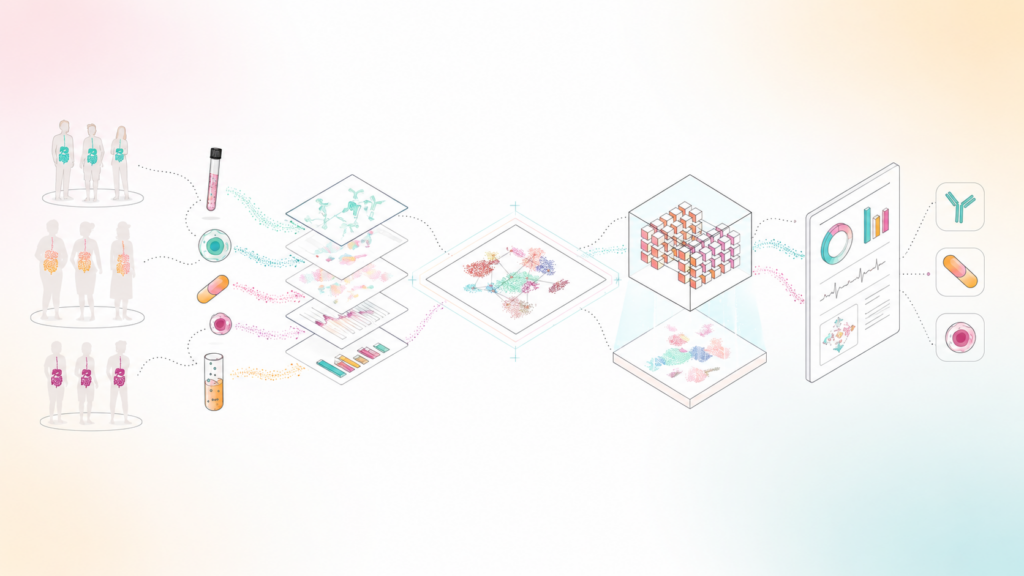
Immunai’s platform integrates biological data from multiple sources to build a comprehensive picture of the immune system and support research and drug development.
Every Sample Brings the Next Breakthrough Closer
Despite its international recognition and the extensive network of collaborations it has already built, Solomon describes Immunai as still early on of its journey. Its platform is currently built on a vast repository of biological data, including over fifty thousands of immune cell samples, but in his view, this is only the starting point. The next goal is far more ambitious.
“We want to reach one million samples. The more diverse the people our model learns from, the better it will become at identifying patterns that cannot be detected in any other way.”
For Immunai, every new sample is much more than another data point. It deepens the understanding of the immune system and strengthens the model’s ability to uncover relationships that would otherwise remain hidden. The better the model understands how the immune system responds to different therapies, the more accurately pharmaceutical companies will be able to decide which drug candidates to advance, select the right patients for clinical trials, and identify promising research directions at an earlier stage.
That is the vision driving the company: transforming vast amounts of biological data into knowledge that can accelerate the development of the next generation of medicines.
“If we understand the immune system better,” Solomon concludes, “we can help develop better medicines, faster, and bring them to more people.”
At a Glance: Immunai
The Mission
To build a digital model of the human immune system that will help develop more precise and effective drugs.
The Challenge
To build a global-scale database that will enable a better understanding of how the immune system responds to diseases and treatments.
The International Collaboration
Joining the World Economic Forum’s Global Innovators community and the C4IR Israel innovation community, which expanded the company’s collaborations with pharmaceutical companies, academic institutions, and healthcare systems around the world.
The Role of the Israel Innovation Authority
The Israel Innovation Authority connected the company to the C4IR Israel innovation community and an international network of partners, helping deepen its global collaborations.
What Comes Next?
To expand the database to one million samples and enhance the model’s ability to support the development of the next generation of drugs.

A Quote Worth Remembering
“If we understand the immune system better, we can help people live healthier lives.”
“Breakthrough technologies do not develop in a vacuum. Turning a scientific discovery into a solution with global impact requires an ecosystem that connects research, entrepreneurship, industry, and policy. The link to the World Economic Forum enables Israeli companies to join global networks, meet strategic partners, and bring their knowledge and innovation to the places where the markets and solutions of the future are being shaped.”
Shlomi Kofman, VP & Head of International Collaborations Division