
ITC taught traffic lights to read the road in real time, while ConnVAS taught infrastructure to anticipate danger. Both turned a pilot into a paying customer
Smart mobility technologies cannot remain confined to the lab. To determine whether a system based on artificial intelligence, computer vision, edge computing, or vehicle-to-vehicle communication can perform in the real world, it must be tested under real-world conditions: on busy roads, at intersections and crosswalks, and across active urban environments. Only there can it be tested against the requirements of local authorities and demonstrate whether it has the potential to become a commercially viable solution.
One of the world’s leading test sites in this field is Curiosity Lab, located in the American city of Peachtree Corners, Georgia. The city has built a unique innovation ecosystem for smart transportation, connected vehicles, and urban infrastructure, allowing companies to test their technologies in an active urban environment alongside local authorities, business partners, and potential customers. As such, the test site also provides companies with an opportunity to enter the US market.
The collaboration with Curiosity Lab, led by the Israel Innovation Authority’s International Division, allows Israeli companies to conduct pilots in an active urban setting, gain access to infrastructure, local authorities, business partners, and prospective customers, and adapt their technologies to the needs of the US market. For some Israeli companies, this is the point at which a prototype begins to evolve into a commercial product.
Two of the companies that participated in the program were ITC and ConnVAS. While both develop smart mobility technologies and tested their solutions at the same site in Georgia, each sought to solve a different transportation challenge.
For Aharon Brauner, co-founder of ITC (Intelligent Traffic Control), it all began with a simple question. “My wife was sitting in traffic and asked why the traffic light was giving a green signal to an empty road while we were stuck waiting,” he recalls. That question prompted Brauner to rethink how intersections are managed around the world. He discovered that most traffic lights still operate according to preprogrammed timing plans based on past traffic surveys, leaving them unable to respond to changing traffic conditions in real time.
The Traffic Light Stops Guessing
Brauner didn’t start out in the transportation sector. Trained as an electrical and computer engineer, he explored several approaches when he set out to turn the idea into reality. One of them came from a completely different field: optimizing the flow of electricity through power grids. “The principle is similar,” he explains. “In one, you try to move as many electrons as possible through an existing network; in the other, you look at how to move as many vehicles as possible through an existing infrastructure.”
After completing their studies, Brauner and Dvir Kenig founded ITC, convinced that traffic could be managed in a fundamentally different way. At most intersections worldwide, traffic lights still operate according to fixed timing plans. Traffic engineers conduct surveys, measure traffic volumes in different directions at various times of day, and use that data to create preset signal plans. The problem is that traffic changes constantly. “I can use our cameras to see exactly what’s happening at any given moment,” says Brauner. “So why should a traffic light rely on traffic counts collected on some random day a few months ago?”
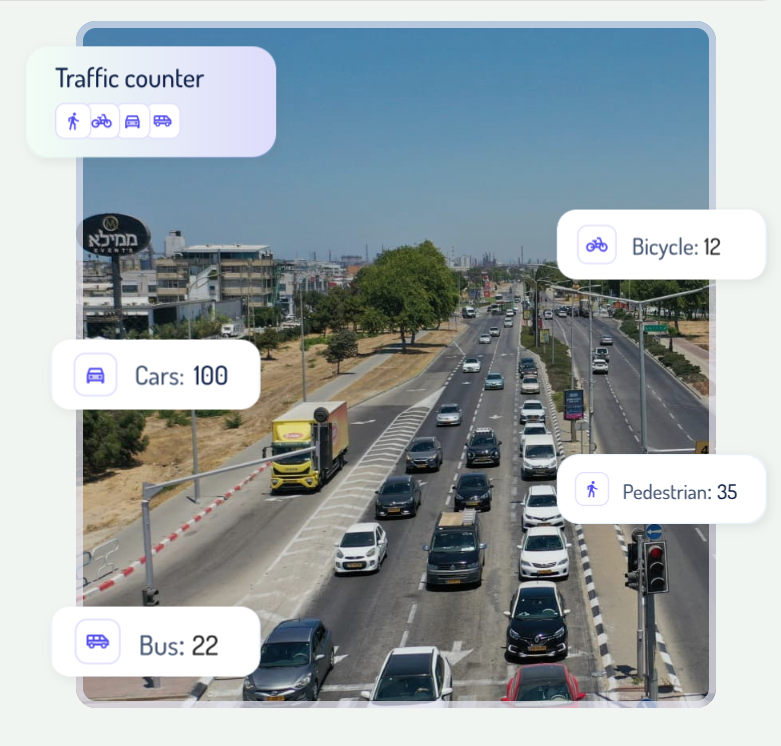
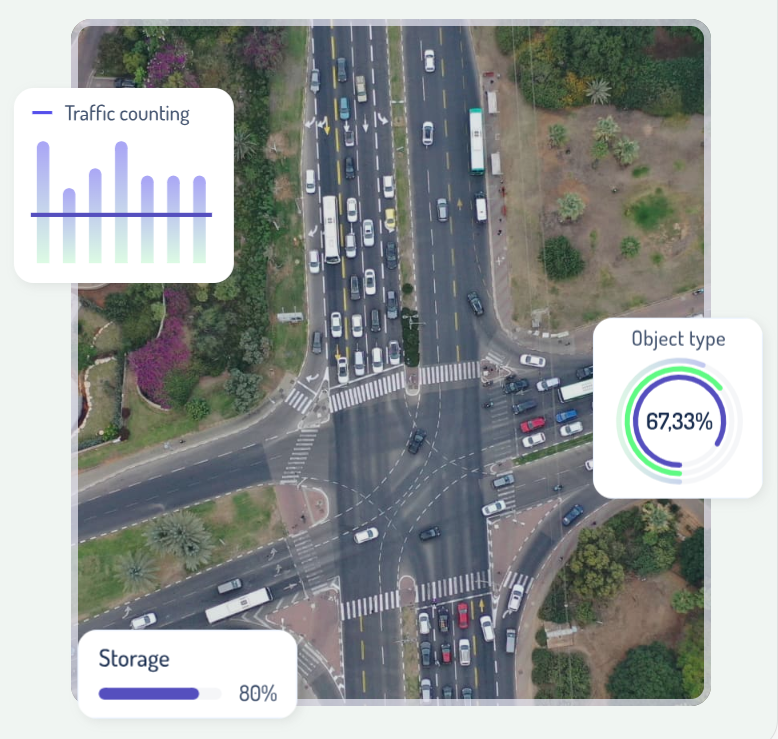
To address this gap, ITC developed VisionFlow, a system based on cameras, computer vision, and artificial intelligence. VisionFlow creates an up-to-date picture of traffic volumes in each direction at an intersection and calculates, in real time, the most efficient signal timing based on the policy defined by the local authority. The system operates on existing traffic signal infrastructure without replacing it or requiring municipalities to purchase proprietary equipment from a particular manufacturer.
“At the end of the day,” Brauner explains, “a traffic light is a decision-making system. The question is what information those decisions are based on.” Brauner emphasizes that traffic policy remains in the hands of the local authority and its traffic engineers, who determine the priorities for each intersection. The system’s role is to implement that policy in real time, during every signal cycle, with a level of precision that cannot be achieved through advance planning.
The technology did not remain theoretical. Today, the company’s systems are deployed at hundreds of intersections, projects, and local authorities across Israel. The company also reports larger-scale orders outside Israel, across several continents. This deployment laid the foundation for the next stage, but also defined the next challenge proving that the technology could work with US infrastructure, under different standards and professional requirements, and in a market where the company was not yet known.
Much More Than Proof of Concept
The opportunity to do so came through the Collaboration Program operated by the Israel Innovation Authority’s International Division. For ITC, the pilot was far more than a technology trial. It enabled the company to examine how the system would integrate with US transportation infrastructure, whether it would meet local regulatory requirements, and how transportation professionals, the people ultimately responsible for deciding whether to adopt it, would respond.
During the pilot, the system analyzed live video from several signalized intersections and calculated the optimal signal plan in real time based on actual traffic conditions. At the same time, it was evaluated for its ability to integrate with local transportation systems and meet US traffic management requirements.
“We were contending with a high level of uncertainty,” Brauner says. “We didn’t know whether what worked in Israel would also work in the US. Once you prove yourself there, you’re starting from a completely different position.”
Following the successful pilot, the Peachtree Corners municipality began moving forward with the installation of cameras at three additional intersections. The company estimates that its entry into the US market will unlock business potential worth tens of millions of dollars over the coming years.
For Brauner, however, the significance is even broader. “No solution can completely eliminate traffic jams,” he says. “Our job is to reduce them, shorten the time people spend in traffic, and ease the congestion they create. If we can achieve that, we will have succeeded.”
After more than six months of testing under real-world conditions, the Peachtree Corners municipality decided to expand the project and became a paying customer. At the same time, business relationships were established with US companies in the field of road infrastructure and with other international companies operating within the city’s innovation ecosystem.
At a Glance: ITC – VisionFlow

The
Mission
To enable intersections to manage traffic in real time using AI and computer vision, rather than relying on preset traffic signal plans.

The
Challenge
To prove that a traffic management system can integrate within existing transportation infrastructure, respond to changing conditions in real time, and improve traffic flow without replacing existing traffic signal systems.

The International Collaboration
The collaboration with Curiosity Lab in Peachtree Corners enabled the company, whose system is already deployed at hundreds of intersections in Israel and which has secured larger-scale orders abroad, to adapt its system to US infrastructure and standards, and open the door to the US market.

The Role of the Innovation Authority
Through its International Division, which established the connection with Curiosity Lab and invested in the project, the Innovation Authority enabled ITC to test its technology in an active urban environment and accelerate its entry into international markets.

What Comes
Next?
Following the successful pilot, the Peachtree Corners municipality is moving forward with installing cameras at three additional intersections. The company estimates business potential worth tens of millions of dollars in the coming years, alongside expansion into additional US cities.

A Quote Worth Remembering
“A traffic light is a decision-making system. The question is what information those decisions are based on.”
An active city is not a sterile laboratory. It exposes technology to changing traffic conditions, existing infrastructure, safety requirements, regulation, and human behavior that cannot be fully replicated in a lab. Connections with international pilot sites allow Israeli companies to test their systems in real-world conditions, demonstrate performance, and develop solutions designed not only for a successful trial, but also for implementation and commercialization.
The Infrastructure Sees Everything
While many companies in the field of smart transportation have focused on the vehicles themselves, ConnVAS chose to start from the infrastructure. “Our long-term goal was to eventually enter the automotive world,” says Yaron Evron, one of the company’s founders. “But we realized that starting there would be extremely challenging. Infrastructure seemed like a much more practical starting point.”
That decision shaped the company’s direction. Instead of developing a system installed inside vehicles, ConnVAS developed a smart platform installed on the urban infrastructure itself. At its core is an industrial edge computer that processes data at the point of collection and is connected to cameras and various communication systems. Using computer vision and artificial intelligence, the computer identifies what is happening across the urban environment in real time and delivers the information to the relevant parties.
According to Evron, the future lies in the ability of all components of the transportation system to exchange information continuously. “The world is moving toward infrastructure that generates information from the road, much like air traffic control systems track everything happening in the sky,” he says. “Transportation systems will detect everything that moves on the roads and share that information with vehicles, traffic management centers, and anyone else who needs it, allowing the entire system to make better decisions.”
To enable this flow of information, the platform relies on Vehicle-to-Everything (V2X) communication, which Evron describes as a kind of Wi-Fi for the transportation world. The technology allows vehicles, infrastructure, and traffic management systems to exchange information in real time, so an event detected by the system can be immediately communicated to a driver, a traffic control center, or any other connected system. For Evron, this is where smart transportation is headed. “In the end,” he says, “everything will talk to everything.”
The choice to start with infrastructure led ConnVAS to its first product: a smart pedestrian crosswalk system designed to address a common problem in many US cities. Flashing warning lights are installed at unsignalized crosswalks to alert drivers to pedestrians who want to cross the road. In practice, however, most pedestrians do not press the activation button at all, so in many cases the system is not activated.
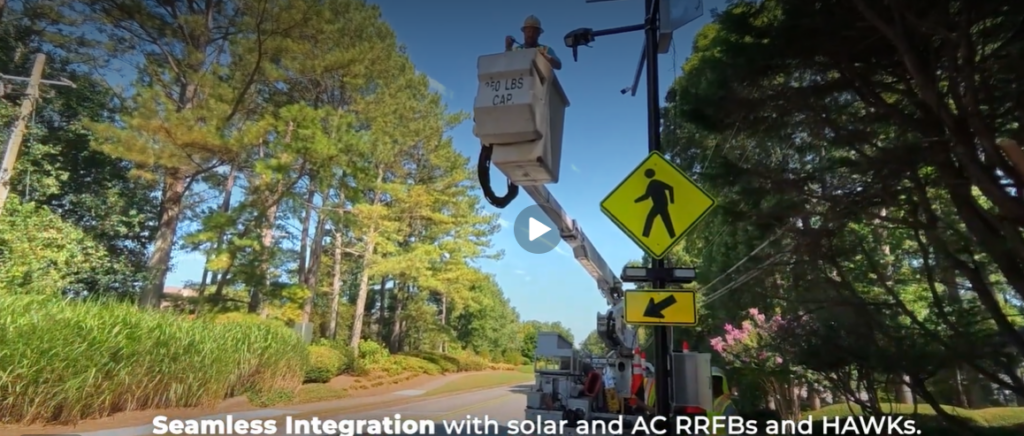
The solution developed by ConnVAS eliminates the need for human intervention. The system automatically detects a pedestrian approaching the crosswalk, determines whether a vehicle is approaching, and activates the warning lights only when necessary. At the same time, it also sends an alert to vehicles equipped with compatible communication systems, even before the driver reaches the crosswalk. “Today’s in-vehicle warning systems react only moments before a collision,” Evron explains. “We want drivers to receive that information much earlier.”
For ConnVAS, however, the pedestrian crosswalk system is only the beginning. The same platform also collects data on crosswalk usage patterns, detects traffic violations, records near-miss incidents, and provides local authorities with a detailed picture of what is happening on the ground. In doing so, infrastructure is transformed from a passive element performing a single task into a source of information that supports decision-making, improves safety, and helps cities plan urban infrastructure based on data.
The Real-World Test
For ConnVAS, the collaboration with Curiosity Lab represented a unique opportunity. “Testing new transportation technologies is incredibly difficult,” says Evron. “There are regulatory requirements and significant responsibility, and rightly so. The moment you introduce a new technology into the public realm, it must not put anyone at risk. Curiosity Lab was created precisely to give companies a place to test these technologies in a real urban environment, through a process that is much faster and more accessible.”
The collaboration with Curiosity Lab began through the Israel Innovation Authority’s International Division, which had already worked with the lab’s team and was familiar with the testing options it offered. “The Israel Innovation Authority encouraged us to participate in the pilot, helped fund it, and connected us with the right people,” says Evron. “The entire process was much simpler and more accessible than we expected.”
The test itself required ConnVAS to demonstrate not only that the technology worked, but also that it could integrate into the urban environment and existing infrastructure. Its success opened business opportunities that would not have been possible without proving the technology in the field. The company began working with local distributors in the United States, established partnerships with contractors who install smart transportation systems, and later teamed up with a Canadian manufacturer of pedestrian crosswalk systems that has integrated ConnVAS’s technology into its products.
For Evron, the pilot was not only a technology test, but also a market test. It gave the company an opportunity to test its solution under real-world conditions, with actual customers, partners, and infrastructure, and to prove that the idea on which the company was founded could work beyond the lab. In that sense, the stories of ConnVAS and ITC are about more than smart transportation. They illustrate the journey deep-tech companies take on their way to international markets. Technology is the starting point. The ability to prove it under real-world conditions is often what determines whether it will become a commercial product.
At a Glance: ConnVAS
The
Mission
To transform urban infrastructure into an active source of information that can detect events in real time, share data with vehicles and control centers, and assist in decision-making on the road.
The
Challenge
To prove that the system can integrate with existing urban infrastructure, meet US regulatory standards, and provide reliable real-time information to improve safety and traffic management.
The International Collaboration
The collaboration with Curiosity Lab enabled the company to conduct a pilot in real-world conditions, demonstrate its capabilities in an active city, and turn technological success into a business opportunity in the US market.
The Role of the Innovation Authority
Through its International Division, the Innovation Authority established the initial connection with Curiosity Lab, accompanied the pilot, and helped the company turn the trial into a commercial collaboration.
What Comes
Next?
Expansion of operations in the United States, more in-depth collaborations in the field of smart infrastructure, and deployment of the platform in additional cities as part of the transition to connected and autonomous transportation.
A Quote Worth Remembering
“In the end, everything will talk to everything.”
“Innovation does not end with developing the technology. Beta sites let companies test their solution in a real-world environment, against existing infrastructure, regulatory requirements, and potential customers. That is how a product is better adjusted, risks are reduced, and a successful pilot becomes a foothold in the international market, as demonstrated by ITC and ConnVAS.”
Shlomi Kofman, VP & Head of International Collaborations Division