
An innovative platform is decoding proteins in breast milk to develop a new series of supplements that replicate their effects in adults. With three products on the market and support from the Innovation Authority, Maolac aims to create a new category of nutrition
The dietary supplement shelves are packed with capsules of omega blends, amino acids, superfood powders, and compounds, all promising to improve concentration, memory, digestion, mood, sleep, and the immune system. The problem is that most of them lack scientific validation, involve lengthy and costly R&D processes, and their success often depends on chance – what works for one group might not work for another.
Maolac offers a different approach by starting with what the human body already knows how to do – with the biological processes that powered life itself at its earliest stage. Instead of inventing yet another supplement, the company aims to decipher the biological function of breast milk and reassemble it into formulations tailored for adults.
The milk involved isn’t human milk, but rather, bovine colostrum, the nutrient-rich liquid produced during the first two days after calving, which contains hundreds of active proteins with proven physiological benefits.
The woman behind Maolac is its founder and CEO, Maya Ashkenazi Otmazgin. Together with a management team composed primarily of women, the team has already brought three products to market and developed a technology that seeks to redefine food supplements. The company’s goal is to design nutrition not by intuition, but rather by science.
Maolac is not designed to imitate human milk, but to understand its biological advantages. Using a proprietary AI-driven platform, the company scans vast protein databases, identifies those with significant biological functions, and assembles them into precise compounds tailored to various health needs.
The system Maolac has developed replaces resource-intensive R&D processes and enables the company to design products that are aligned with the body’s own mechanisms, ensuring bioavailability, stability, and safety. What once required expensive labs and large research teams can now be done faster and more efficiently within a single development environment.
From Barn to Lab
Colostrum, the first milk produced after birth, is considered a critical component in developing mammals’ immune systems. It contains exceptionally high concentrations of antibodies, growth factors, and active proteins designed to protect the body from external threats. In recent years, research has shown that these same components may also benefit adults experiencing immune stress, aid recovery processes, and enhance the body’s natural defense mechanisms.
A biopharma engineer by training, Ashkenazi Otmazgin founded Maolac in early 2021 through the Innovation Authority’s Incubators Program. Since then, the company has raised millions of dollars, established a working production facility, and contributed to setting new regulatory standards for colostrum in Israel. Maolac has also launched three flagship products focused on immune system support, muscle recovery, and gut health, with a fourth product already in development.
Each of Maolac’s core products, already sold internationally, targets a distinct audience.
The first supports gut health by creating an anti-inflammatory environment around tissue, allowing the existing microbiome to thrive.
The second aids in muscle mass recovery and maintenance, specifically targeting athletes and active older adults with complex nutritional needs.
The third provides a more sophisticated alternative to generic colostrum products, which currently dominate the global 5 billion dollars global market. It features a concentrated, clean, and stable formula that meets rigorous quality standards.
By combining machine learning, pharmacology, molecular biology, agriculture, and other disciplines, Maolac is redefining the nutritional supplement industry and demonstrating the global potential of Israeli innovation beyond the lab, incubator, and even the barn.
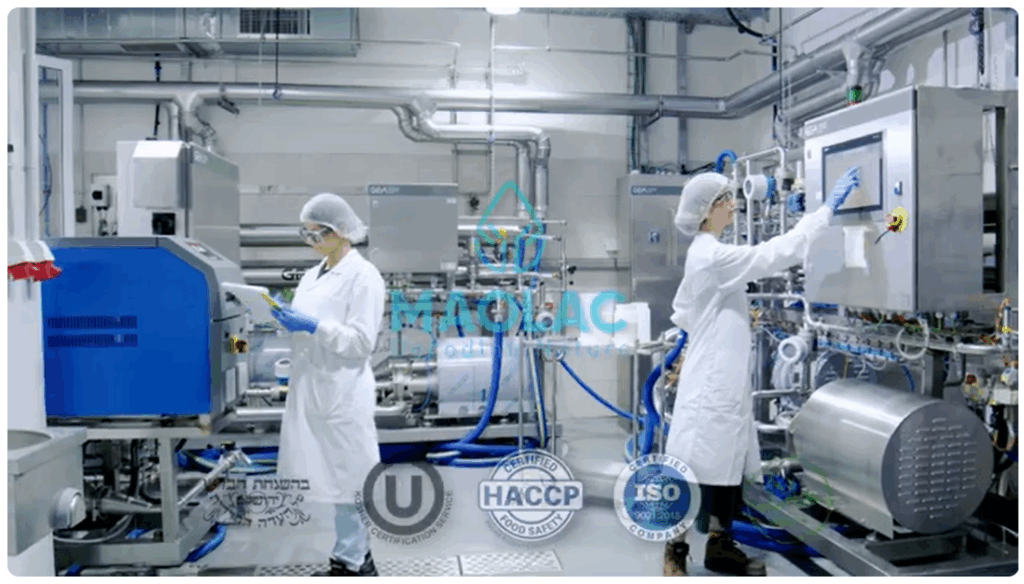
Although its raw materials are derived from nature, Maolac’s use of them is anything but conventional. The colostrum at the heart of its products is sourced from Israeli dairy farms, only after the calves receive their share. It then undergoes an extraction and purification process tailored to a specific protein profile, followed by adaptation to ensure heat and acidity resistance. This method preserves biological activity through industrial production without relying on flavorings. The result is a versatile nutritional ingredient, suitable for use in a wide range of formats, from beverages and powders to gels and gummies.
Each supplement begins with a deep understanding of what nature has long since known: the close connection between colostrum and the rapid development of tissues, cell renewal, and immune reinforcement. Maolac’s technology focuses on deciphering how proteins operate within human biological systems.
The company first built a unique library of more than 1,500 active proteins identified in human breast milk, recognizing that it is their composition, and not a single protein, that is the key to the maturation of the immune, digestive, and muscular systems.
Maolac’s AI platform is built upon this library, generating “functional maps” of proteins in the human body, using data mining, machine learning, and simulations. Each protein is analyzed according to its amino acid sequence, structure, and function, resulting in a smart, clever, and innovative model for assembling tailored compounds for different health indications.
The breakthrough lies not only in identifying proteins, but in transforming them into actual products. By understanding the structure of each component, the system can identify natural equivalents such as fungi or plants and predict which will be able to imitate the function of breast milk proteins successfully. The outcome: biological dietary supplements, made from safe and accessible natural sources, that work in the body in a manner that is both familiar and natural.
From Incubator to Market, From Idea to Industry
According to Ashkenazi Otmazgin, the Innovation Authority has been one of the key enablers behind Maolac’s rapid growth. The Authority has supported the company through three different programs along the way: initially via the Strauss Group’s “The Kitchen” incubator, later through the MoFET Track, and currently under the Round A Track, designed for mature companies with commercial activity that are raising their first significant funding round.
“It’s much more than a financial grant,” explains Ashkenazi Otmazgin. “The Innovation Authority accompanies companies throughout their entire lifecycle. That continuity allows us to move gradually – from idea to product, from lab to market – without the constant fear that funding will run out every few months. The Authority’s investment is particularly vital in foodtech and biotech, where regulatory risks are high, development cycles are long, and economic obstacles are numerous.”
Beyond providing financial oxygen, the Innovation Authority also serves as a significant seal of quality, especially when speaking with international investors. “It’s more meaningful than ever,” she adds, “at a time when global investment is slowing down, including the unfortunate recent decision by the European Union to cut startup funding. Israel must maintain a stable support infrastructure that helps build industries, not just develop ideas.”
As a result, Maolac has become part of a fully active industrial ecosystem. The company developed a product, established a production plant, introduced new regulations for colostrum, and partnered with Israeli dairy farms to create a new revenue channel for local farmers. In other words, beyond its nutritional innovation, Maolac is shaping an entire model of a new agri-tech industry.
The Goal: Meeting Demand
Although Maolac’s headquarters are based in Tirat Carmel, most of its operations are directed toward markets in the United States, Singapore, South Korea, and Japan. In Israel, however, the road has been more complicated, not because of a lack of interest, but rather due to the absence of regulation. Until recently, colostrum was not even defined as a raw material approved for marketing, forcing Maolac to initiate collaboration with the Ministries of Health and Agriculture to establish a regulatory framework process.
“For three years, we worked to establish regulation that simply didn’t exist,” says Ashkenazi Otmazgin. “We created a new category, generated a new source of income for local dairy farms, and began exporting active ingredients to global markets.”
The process also included complying with international standards, such as FDA approval, European export certifications, and strict WADA standards for sports testing. “Our colostrum is the only one that passes all these tests,” she notes. “It contains no hormones, antibiotics, or drug residues, and that is an integral part of our vision.” The next goal is to expand production and distribution to Western Europe and additional Asian markets.
With degrees in pharmaceutical and biomedical engineering, Ashkenazi Otmazgin’s career path did not initially lead her toward AI-driven biology or dietary supplements. But the birth of her first daughter raised a simple question: “Why should breast milk only be for babies? Why not learn from it, break it down into its components, and rebuild something that could also serve adults?”
This idea, which initially sounded provocative, became the spark behind a company born without financial backing or an established network of connections. Today, less than five years after its inception, Ashkenazi Otmazgin leads an international company with an operational production plant, registered patents, partnerships with global brands, and product inventories that have sold out due to soaring demand.
Future plans include establishing an additional production facility in the southern Golan Heights, intended to work with dairy farms across Israel and enable industrial-scale production of high-quality colostrum suited for global export. “The market is ready,” she says. “We just need to keep up with the pace.”
Maolac does not intend to stop at colostrum. Teams are already working in their labs to develop parallel bioactive ingredients from plant-based sources such as fungi, algae, and legumes, to create vegan formulas with biological activity identical to that of breast milk-derived proteins.
According to Ashkenazi Otmazgin, the company’s long-term vision is to build a structured “biological alphabet” – a system from which precisely tailored supplements and products can be designed for a wide range of applications: immune system support, skin regeneration, hormonal balance, and even neurology, cosmetics, and preventive medicine.
In the coming years, Maolac plans to establish an additional R&D center outside Israel, in a hub that will enable collaborations with universities and pharmaceutical companies to accelerate research and market expansion.
“Israel’s high-tech ecosystem continues to navigate significant challenges, and the Deeptech Startup must therefore serve as a committed partner in this journey and ensure that innovation is consistently supported with the necessary resources and a clear pathway for sustainable growth.”
Dror Bin, CEO of the Israel Innovation Authority