
Introduction
Data centers are physical and digital infrastructures that consolidate large-scale computing, storage, communications, data processing, and connectivity systems. They form the infrastructure layer underpinning cloud services, AI, financial systems, government services, defense systems, communications networks, streaming services, digital commerce, data storage, and critical enterprise applications. In the past, data centers were viewed primarily as technology operations facilities or as a supporting component of IT systems. Today, they are gradually becoming strategic infrastructure with a direct impact on economic growth, digital sovereignty, energy security, national resilience, and the ability of countries and companies to participate in a data- and AI-driven economy.
In recent years, the data center sector has undergone significant change. Continued growth in cloud services and data storage and processing, together with the surge in compute-intensive AI workloads, is rapidly increasing demand for computing capacity and electricity. Modern data centers must support substantially heavier workloads than in the past, particularly for training and operating AI models, using graphics processing units, AI accelerators, high-speed communications networks, high-throughput storage, and advanced cooling systems. As a result, power density in facilities is increasing, electricity consumption is rising, cooling is becoming more complex, and rapid, stable, and reliable access to the power grid is becoming increasingly important. In this context, reports by the European Commission from November 2025 and Bloomberg from May 2026 indicate that data centers currently account for approximately 1.5-2% of global annual electricity consumption, with demand expected to double or more by 2030.
Accordingly, optimizing energy consumption in data centers is no longer merely a technical matter of designing more efficient buildings or purchasing more energy-efficient servers. It is a systemic field encompassing the entire data center value chain: site selection, grid connection, land availability, the energy mix, energy storage, cooling, water use, heat reuse, workload management, operational monitoring, cybersecurity, infrastructure resilience, regulation, and sustainability metrics.
The central challenge in this field is that demand for computing capacity and electricity is growing faster than the pace of adaptation of electricity, cooling, planning, and regulatory infrastructure. Even when more efficient technologies are available, they are not always deployed quickly enough. When data center development outpaces the expansion of power infrastructure, significant bottlenecks may arise, including grid connection delays, regional grid congestion, competition with other consumers, higher infrastructure costs, and public opposition. Some solutions are costly, some are difficult to implement in existing facilities, and others require coordination among multiple stakeholders, including data center operators, utilities, cooling companies, real estate developers, regulators, planning authorities, cloud providers, hardware companies, and cybersecurity companies.
These are multilayered systems; therefore, no single solution is suitable for all data centers. Energy consumption is affected by a wide range of factors, including server efficiency, cooling systems, site location, local climate, workload type, hardware utilization, the energy mix, water constraints, the ability to reuse excess heat, permitting policies, and the availability of transmission and distribution infrastructure. A site in a cool climate, with access to renewable electricity and the ability to feed excess heat into a district heating network, differs from a site in a hot or densely populated country, or one with grid constraints. Even within the same market, there are significant differences between older and newer facilities, hyperscale cloud data centers and smaller enterprise facilities, and stable workloads and variable, dynamic AI workloads.
The solution to data center efficiency challenges is therefore not a single technology, but an ongoing combination of infrastructure planning, regulation, measurement, incentives, workload management, renewable energy, advanced cooling, and improved equipment life cycles, in a way that balances the needs of digital growth with constraints on electricity, water, land, and climate.
Leading Technologies
Data center optimization technologies can be divided into two categories: direct optimization technologies and indirect optimization technologies.
Direct optimization technologies

Directly reduce energy consumption or improve the management of electricity, cooling, heat, and water in data centers. These include energy and storage solutions, advanced cooling, heat reuse, reduced water consumption, and operational monitoring.
Indirect optimization technologies
Do not necessarily reduce electricity consumption immediately, but they enable greater computing output from the same infrastructure or the same amount of energy. These include efficient chips, AI accelerators, high-speed connectivity, advanced storage and memory, workload management software, and cybersecurity and infrastructure resilience.
 Direct Optimization Technologies:
- The energy and storage category includes solutions for power supply, backup, energy storage, load management, grid integration, and reducing energy losses. Large data centers require a continuous and reliable power supply, making backup and storage systems an integral part of their design. Energy storage systems can help address peak loads, improve the integration of renewable energy, enable rapid response to emergencies, and reduce pressure on the grid during periods of high demand. In addition, distributed power generation or generation located near data centers can reduce dependence on the central grid, particularly in areas where grid connection capacity is limited.
- Cooling and thermal management are another key focus, as a significant share of data center energy consumption stems from the need to remove heat and maintain stable operating conditions. As computing workloads increase and power density rises, traditional air cooling becomes less effective at dissipating heat. Liquid cooling transfers heat more efficiently than air and is therefore particularly suitable for high-performance processors and AI workloads. Direct-to-chip cooling removes heat directly from the heat source, while immersion cooling allows servers or components to be submerged in a non-conductive dielectric fluid. These solutions can improve cooling efficiency, support higher densities, reduce facility space requirements, and, in some cases, reduce water or energy use.
Heat reuse is also part of thermal management. Data centers generate large amounts of heat, which, rather than being released into the environment, can be used to heat buildings and greenhouses, support industrial processes, or power absorption-based cooling systems. In colder countries, heat reuse can be integrated into district heating networks. In hot countries such as Israel, the potential is more complex, but remains relevant, particularly where excess heat can be directed to nearby industrial or agricultural uses.
Water use and resource efficiency are becoming increasingly important as data centers grow.Some cooling systems use water, and in some cases improving energy efficiency may increase water consumption. Possible solutions include using recycled water, water-efficient cooling systems, dry or hybrid cooling, monitoring water use efficiency, adapting cooling technologies to the local climate, and using water sources that do not directly compete with municipal or agricultural consumption.
- Operational monitoring and optimization constitute a key management layer. Software systems, sensors, and AI make it possible to monitor electricity consumption, heat, water, workloads, availability, failures, server utilization, and cooling system performance. AIOps systems can identify anomalies, predict failures, recommend corrective actions, and schedule workloads in ways that reduce waste. Monitoring is therefore not merely a control tool, but a component that enables data centers to operate as more dynamic and flexible systems.
 Indirect Optimization Technologies:
- The advanced chips and computing power category includes GPUs, AI accelerators, HPC systems, new processing architectures, and specialized chips. Their contribution to optimization stems from the ability to deliver more computing output per unit of energy. The more efficient the hardware and the better the software utilizes it, the more training, inference, or data processing can be performed using the same infrastructure.
- Connectivity and data networks are a particularly critical layer in high-power data centers. When servers, GPUs, storage systems, and management systems cannot communicate quickly enough, delays are created, and expensive hardware remains underutilized. Connectivity components and fiber management enable faster data transfer, lower latency, and better utilization of computing resources.
- Memory, storage, and data access also affect data center efficiency. NVMe, SSD, NVRAM, storage controllers, deduplication, replication, and intelligent data management enable faster access to data and reduce delays between the computing and storage layers. In data centers that process large volumes of data, these components are central to operations.
- Cybersecurity and infrastructure resilience do not reduce server electricity consumption, but they help minimize downtime, data loss, disruption to critical services, and resource waste caused by failures and attacks. In energy-intensive data centers, downtime and failures can be costly and may lead to inefficient use of backup, recovery, and emergency operation systems. Infrastructure resilience is therefore part of overall system efficiency.
Future data centers are expected to develop along two parallel paths:
- Physical infrastructure: Deep infrastructure solutions that transform the physical infrastructure, such as liquid cooling, immersion cooling, modular data centers, green data centers, energy storage, renewable energy, heat and water reuse, microgrids, and mobile data centers.
- Computational and operational: Indirect optimization solutions that are easier to implement in existing facilities, including energy-efficient chips, AI accelerators, high-speed connectivity, advanced storage, workload management, AIOps, and dynamic resource optimization.
In the future, data centers will be measured not only by their capacity or physical size, but also by their ability to generate maximum computing output from minimum resources while maintaining availability, resilience, security, and compliance with sustainability metrics. Policy and regulation are expected to play a central role in accelerating this transition, as some physical solutions remain costly or complex to implement without incentives, standards, reporting requirements, or changes in the underlying economic viability.
The Israeli Ecosystem
Israel has activity in both direct and indirect data center optimization, but the picture is not symmetrical. Israel’s comparative advantage currently lies primarily in indirect optimization. There is also activity in direct optimization, but it is more limited and, in many cases, is still at the stage of potential repurposing or adaptation. Mapping of Israeli companies identified 28 companies operating in direct optimization (as shown in Figure 1) and 55 companies operating in indirect optimization (as shown in Figure 2). In direct optimization, monitoring and optimization companies are particularly prominent, alongside a smaller number of companies in energy, storage, cooling, and thermal management. Indirect optimization has a broader presence, particularly in connectivity, storage, chips, and cybersecurity.
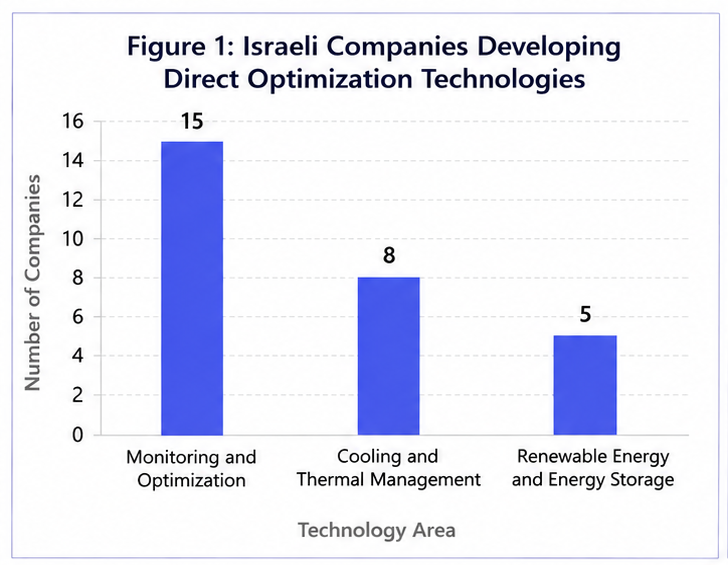
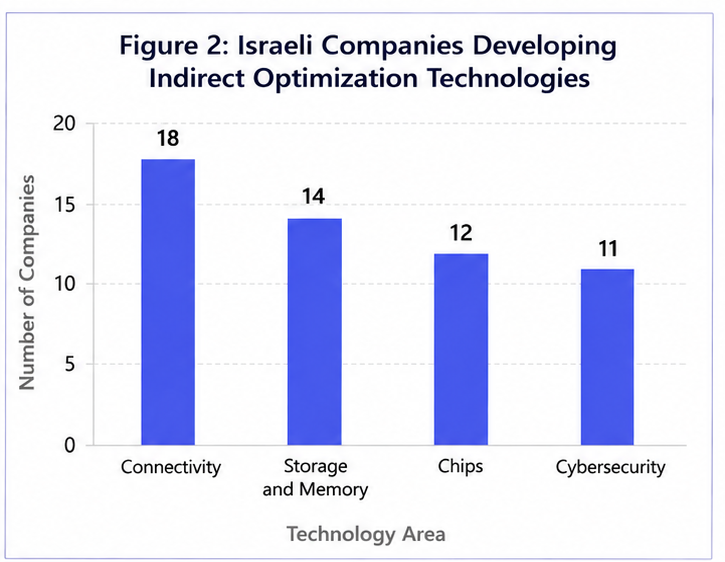
Source: Analysis of IVC and PitchBook data
Beyond companies that specifically target data centers, Israel has many companies operating in water, water treatment, energy storage, green energy, power electronics, optimization, and software that could become relevant if they adapt their solutions to the data center sector. The growth potential is therefore not limited to companies already active in data centers, but also includes companies that could adapt existing technologies for cooling, monitoring, energy management, water treatment, and AI workload management applications.
More broadly, Israel’s data center ecosystem is not based solely on technology companies, but on a combination of several types of players: data center operators, real estate and infrastructure developers, energy and grid connection companies, construction and engineering companies, and technology companies specializing in cooling, monitoring, workload management, connectivity, and cybersecurity. In Israel, such collaborations can be seen both in general development and operation projects and in more targeted energy-efficiency projects.
In the development and construction segment, notable collaborations include partnerships between data center operators and real estate and infrastructure developers, such as the NED and Levinstein Group project to establish an underground data center in Netanya, and the MedOne, Mivne, and Digital Realty data center project in Petah Tikva. In the energy segment, there is a discernible trend toward integrating data centers with nearby power generation sources, renewable energy, or storage, reflecting the understanding that grid connection and electricity availability are major constraints. Examples include Enlight’s project in Ashalim, which combines a data center with renewable energy generation and storage, and the collaboration between Keystone and the IPM power plant in Be’er Tuvia, based on establishing a data center adjacent to existing power generation infrastructure. In cooling and energy efficiency, collaborations are underway on advanced cooling solutions, particularly liquid cooling for AI workloads, to enable higher power density, reduce electricity and water consumption, and improve operational stability. In this context, ZutaCore stands out for its collaborations with Munters and Carrier to advance direct-to-chip two-phase liquid cooling solutions.
Research activity in Israel that explicitly focuses on data centers as an application area is still relatively limited. However, there is a broad community of researchers working in adjacent and relevant fields, including cooling, heat transfer, energy storage, two-phase systems, computer architectures, HPC, connectivity, storage, cybersecurity, optimization, and cloud resource management. In other words, Israeli expertise already exists across many relevant fields, but it is not always organized around the data center challenge as a defined target area. Academic-industry consortia, joint pilots, and applied research programs could therefore create significant value.
Based on the companies and researchers active in Israel, several notable comparative advantages can be identified:
- Expertise in cybersecurity, infrastructure protection, information security, disaster recovery, and operational continuity: Data centers are highly sensitive infrastructure, and the ability to integrate cybersecurity, operations, monitoring, and resilience is a significant asset.
- Capabilities in connectivity, chips, storage, and software: High-power data centers require not only electricity and cooling, but also high-speed networks, advanced data management, high hardware utilization, and software that manages workloads intelligently.
- Experience with hardened and underground infrastructure: Israel has facilities that place particular emphasis on physical protection, security, business continuity, and resilience to security and climate-related threats. In a global context, this is a significant advantage. Many countries are beginning to treat data centers as critical infrastructure, but not all have operational experience in designing resilient facilities in a complex security environment.
- Ability to operate under constraints: Israel is a hot and relatively densely populated country, with limited land and water resources and significant security requirements. These very constraints can become a driver of innovation. Water-efficient cooling, smart energy management, hardened facilities, energy storage, optimization, and workload management are all areas in which local experience may be relevant to countries facing similar challenges.
Global Perspective
The global data center market is expanding rapidly. Among the trends observed worldwide are the following:
- A shift from viewing data centers as real estate and technology projects to treating them as national infrastructure. Countries are beginning to assess data centers not only in terms of their contribution to the digital economy, but also in terms of their impact on the electricity system and the environment.
- Closer integration between data centers and energy: energy storage, nearby power generation, renewable energy, demand management, load flexibility, and grid connection arrangements.
- Measurement-based regulation: reporting requirements, efficiency metrics, transparency regarding water and electricity consumption, and future standards.
- Stronger resilience and cybersecurity requirements: particularly in countries that recognize data centers as critical infrastructure.
From a technological perspective, there is extensive global activity in direct optimization, in contrast to Israel, where the main comparative advantage currently lies in indirect optimization layers. This gap presents both a challenge and an opportunity: Israel is not necessarily a global leader across all areas of physical infrastructure, but it can play a role in high-value layers such as optimization, connectivity, cybersecurity, monitoring, and smart operations. In this context, a mapping of global companies identified approximately 1,610 companies operating in direct optimization (as shown in Figure 3) and 755 companies operating in indirect optimization (as shown in Figure 4).
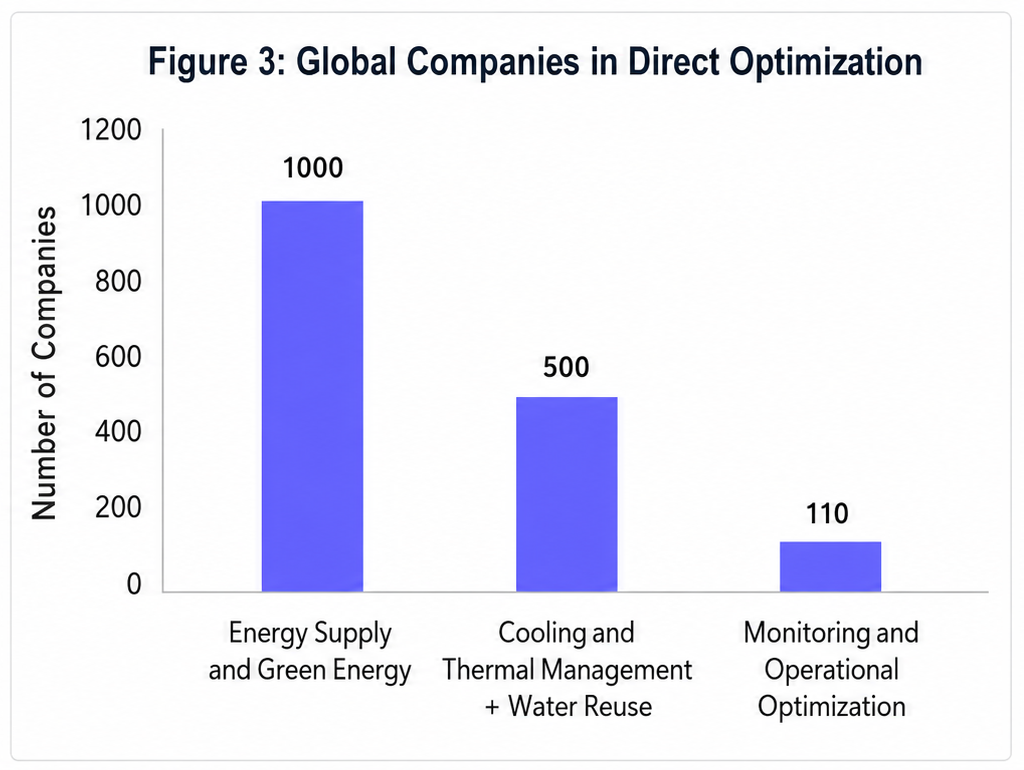
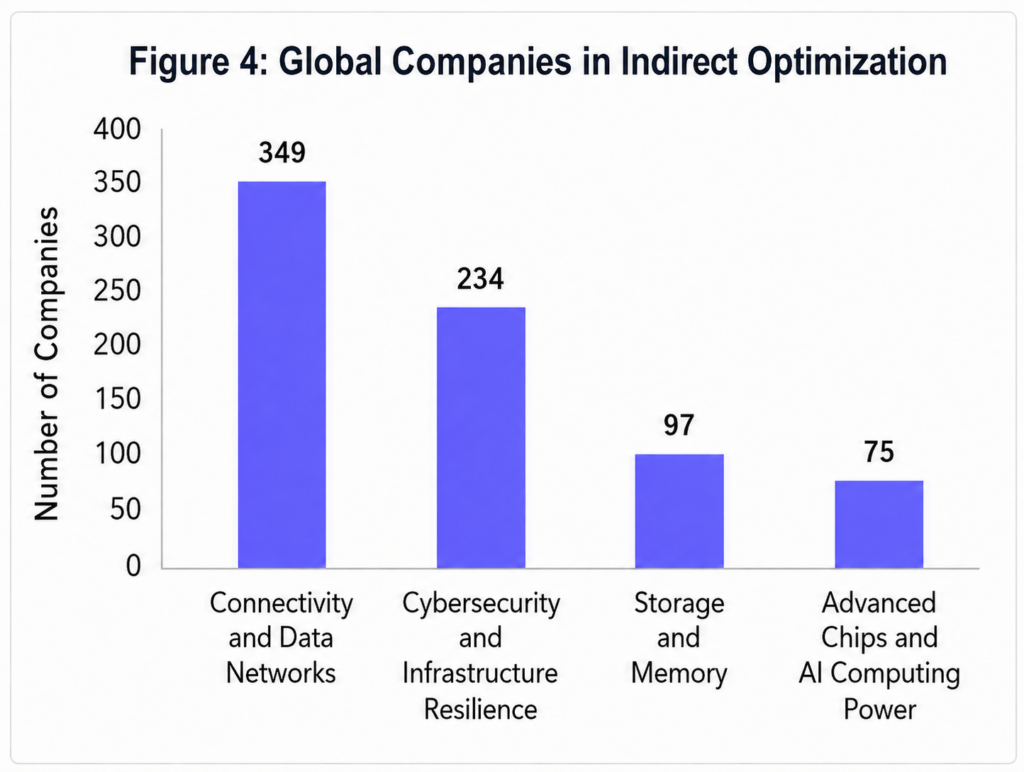
Source: Analysis of IVC and PitchBook data
Below are examples of how countries are choosing to develop the sector within their borders:
The European Union is leading with a regulatory and measurement-based model. The emphasis is on reporting requirements, transparency, sustainability metrics, and creating a database that will enable comparisons across facilities and countries. The European approach is based on the understanding that the data center sector cannot be effectively managed without reliable data on energy consumption, water use, land area, IT capacity, heat reuse, and the share of renewable energy. In the future, this approach is expected to evolve from reporting standards alone toward ratings, minimum performance standards, and incentives or restrictions based on environmental and operational performance.
Singapore is an example of a hot, densely populated country with limited land resources, where uncontrolled data center growth cannot be permitted. The Singaporean model therefore focuses on managed growth, energy efficiency, cooling trials, stringent standards, and the integration of green energy. In addition, Singapore’s development and regulatory authority in digitalization has published a roadmap intended to enable the continued growth of data centers in Singapore while reducing their environmental impact and improving the efficiency of digital infrastructure. For Israel, Singapore represents a particularly relevant comparative model for policy learning, as it also faces constraints related to climate, land, and resources, while aspiring to remain an advanced technology hub.
Ireland and the United Kingdom illustrate the importance of the relationship between data centers and the electricity grid. Ireland has become a major data center hub, but rapid growth has placed significant pressure on the electricity system. As a result, Irish policy has become more conditional: new data centers are required to demonstrate generation or storage capabilities and reduce one-sided pressure on the grid. The United Kingdom, by contrast, places greater emphasis on resilience and cybersecurity, while also enabling innovation in the energy sector through regulatory sandbox frameworks.
The United States represents a more decentralized model. The US market is very large, but policy varies by state. In some cases, data center developers turn to on-site power generation to bypass grid connection constraints. In Texas, the emphasis is on regulating large loads through the electricity system, including connection conditions, transparency, cost allocation, demand management, and load flexibility. The central lesson is that as data centers become very large electricity consumers, there is a need to determine who bears the infrastructure costs they create.
Regulation and Barriers
In recent years, the data center sector has been undergoing a profound regulatory and infrastructure transformation: from facilities once viewed as IT projects or technology-oriented real estate developments to part of countries’ strategic infrastructure systems. Regulation in this field is therefore no longer limited to building permits or business licensing. Still, it must address systemic questions: where data centers should be located, who bears the costs of grid connection and upgrades, how energy and water efficiency should be measured, how environmental impacts can be reduced, and how operational continuity and the protection of critical digital infrastructure can be ensured.
In Israel, the sector is still at the policy development stage. There is currently no dedicated and comprehensive regulatory framework for data centers, but there is a clear trend toward recognizing them as national infrastructure. The main initiative is an amendment to the Planning and Building Law that would allow data centers to be included in the definition of national infrastructure. This means that certain projects could proceed through the preferred National Infrastructure Committee (VATAL) track, rather than relying solely on lengthy local or district planning procedures. However, even a preferred track does not eliminate the need to comply with planning requirements, electricity connection, safety, business licensing, fire safety, hazardous materials, backup systems, noise, environmental permits, information security, and local requirements. Effective regulation in Israel therefore requires coordination among government ministries, planning authorities, the Electricity Authority, Noga, the Ministry of Environmental Protection, the Israel National Cyber Directorate, local authorities, and industry players.
The policy direction in Israel is expected to shift from a reactive model to a priority-driven model. In other words, the state would not merely approve or reject projects, but would guide the deployment of data centers according to the availability of electricity, land, and infrastructure. In this context, interministerial recommendations emphasize prioritizing development outside the country’s central region, shortening planning procedures in preferred areas, preventing speculative grid connection requests, and creating stronger links between data centers and renewable power generation areas. This direction reflects an understanding that large data centers are no longer ordinary commercial electricity consumers, but capital-, electricity-, and land-intensive infrastructure projects that may affect energy system planning and the broader physical environment.
Globally, data center regulation is shifting from local, project-specific regulation toward a more systemic approach. In the past, data centers were addressed mainly through existing regulatory tools, including building permits, business licensing, grid connection, safety requirements, noise regulations, fire safety, and environmental permits. Today, following the rapid growth in cloud and AI workloads, data centers are increasingly viewed as strategic infrastructure with broad implications for electricity systems, land use, water resources, emissions, information security, cybersecurity, and digital sovereignty. As a result, many countries are beginning to develop more dedicated policies that go beyond project-by-project approval and examine the sector’s cumulative impact on national infrastructure.
The main global regulatory trend is a shift toward data- and condition-based management. Rather than allowing unrestricted growth of data centers, regulators are seeking to understand and measure electricity consumption, water consumption, energy sources, heat reuse, cooling efficiency, resilience levels, and impacts on the electricity grid. Accordingly, reporting requirements, efficiency metrics, grid connection conditions, requirements for storage or load flexibility, environmental standards, and in some cases stricter cybersecurity and operational continuity requirements are being developed. At the same time, many countries are attempting to balance the desire to attract investment in cloud and AI infrastructure with the need to protect the public from rising electricity costs, grid congestion, increased water consumption, and environmental harm. Global regulation is therefore moving toward an approach in which data centers are assessed not only by their contribution to the digital economy, but also by their ability to integrate responsibly into electricity, environmental, and national security systems.
The barriers in Israel and globally are similar in nature, but vary in severity depending on local conditions:
- The most significant barrier is electricity availability and the pace of grid connection: Data centers, particularly those designed for AI workloads, consume exceptionally large amounts of electricity and require a stable, continuous power supply with high levels of redundancy. The energy barrier is not merely an operational issue for technology real estate developers, but a systemic challenge involving power grid planning, power plant construction, transmission, storage, and the rapid connection of new facilities.
- Engineering and operational barriers: These barriers stem from the transition from traditional IT workloads to AI workloads. Data centers designed for relatively stable workloads are not always suited to high power densities, variable energy consumption, liquid cooling, densely packed GPU racks, and the need for dynamic management of computing, electricity, and cooling resources.
- Electricity transmission, distribution, and conversion losses: Computing components themselves operate on direct current, while the power grid supplies alternating current. As a result, electricity is converted at various stages, causing energy losses. In large facilities, these losses can become highly significant, and efficient electrical design, fewer conversion stages, and suitable infrastructure can help reduce some of this energy waste.
- Supply chains and critical components: High-power data centers depend on components such as GPUs, chips, communications equipment, storage systems, batteries, power electronics, and critical raw materials. The availability and cost of these components, as well as dependence on supplier countries, are becoming strategic risks. This barrier is not unique to Israel, but it may be particularly significant there due to the relatively small market size, dependence on imports, and the need to ensure security of supply for critical infrastructure.
- Local infrastructure and natural resources: Data centers place pressure on local infrastructure and natural resources, particularly water and land. Advanced cooling systems may increase water consumption or operating costs, and in hot regions or areas where water resources are sensitive, this may become an environmental and public concern. In Israel, the hot climate, the need for continuous cooling, and constraints on land and water resources require careful consideration of facility location, cooling methods, and local impacts.
- Environmental, social, and regulatory barriers: Data centers may face public opposition due to electricity and water consumption, noise, land use, generator emissions, and rising infrastructure costs. At the regulatory level, uncertainty regarding reporting requirements, efficiency metrics, connection conditions, environmental responsibility, and cost allocation may create uncertainty for investors and developers. Effective regulation must therefore balance encouraging investment and the development of AI infrastructure with safeguarding the stability of the electricity grid, natural resources, the environment, security, and operational resilience.
In conclusion, Israel and the rest of the world face the same central question: how to enable the growth of data centers without allowing them to become an unmanaged burden on electricity, water, and land infrastructure. In Israel, the emphasis is on policy development, recognizing data centers as national infrastructure, prioritizing locations, and connecting them to renewable power generation. In other words, this means a transition to systemic regulation, in which data centers are not merely digital facilities, but an integral part of energy, environmental, planning, and national security policy.
Strategic Opportunities for Israel
Israel’s main opportunity is not necessarily to become the world’s largest data center market, but to become a provider of solutions, knowledge, technologies, and operating models for countries and companies building data centers in the AI era. Israel’s advantage lies in the combination of cybersecurity, connectivity, chips, storage, software, optimization, hardened infrastructure, and experience operating in complex environments.
The following are possible directions for action in this field:
- Establishing pilot projects in Israel: Pilots can test the integration of advanced cooling, energy storage, workload management, operational monitoring, heat reuse, water reuse, and operational cybersecurity. Such pilots could be carried out in existing data centers, new projects, or hardened facilities, and could serve as a basis for international demonstration.
- Fostering consortia: Bringing together Israeli companies, data center operators, energy companies, cooling companies, real estate developers, research institutions, and governments. Such a consortium could develop integrated solutions rather than stand-alone technologies. For example, a hardened data center combining liquid cooling, energy storage, workload monitoring, operational cybersecurity, and renewable energy.
- Collaborating with hot, densely populated, or water-constrained countries: Countries such as Singapore, India, and countries in Africa face similar challenges related to climate, land, water, and growing demand for computing capacity. Israel can offer them solutions in cooling, monitoring, cybersecurity, resilience planning, and the operation of sensitive facilities.
- Helping countries build cybersecurity and resilience layers for data centers: As data centers are increasingly recognized as critical infrastructure, the need is growing for solutions in protection, monitoring, disaster recovery, business continuity, physical protection, and supply chain security. This is an area in which Israel has a clear advantage.
- Developing regulation and metrics in Israel in a way that enables innovation and infrastructure oversight: Israel could adopt a phased model consisting of basic reporting requirements for energy and water metrics; incentives for cooling and storage solutions; prioritization of projects in suitable areas; and links between government support and compliance with efficiency and resilience metrics.
Summary
In recent years, data centers have evolved from supporting technological infrastructure into strategic infrastructure. Demand for cloud services, artificial intelligence, and data processing is rapidly increasing electricity consumption, power density, and requirements for cooling, connectivity, backup, and resilience. Data center optimization is therefore no longer an internal engineering challenge, but a systemic issue connecting energy policy, land planning, water, the environment, regulation, cybersecurity, and national security.
Addressing this field requires a combination of direct and indirect optimization technologies. On the direct side, solutions are needed in energy, storage, cooling, heat reuse, reduced water use, and operational monitoring. On the indirect side, efficient chips, high-speed connectivity, advanced storage, workload management, cybersecurity, and resilience are required. Combining these layers will enable data centers to generate more computing output while reducing pressure on electricity, water, and land resources.
Israel has a significant opportunity. The local ecosystem is particularly strong in cybersecurity, connectivity, chips, storage, software, optimization, and hardened infrastructure. At the same time, there are gaps in the core physical areas of direct energy optimization, particularly cooling, energy, water, and heat recovery. This gap is not only a weakness, but also an opportunity for targeted policy: encouraging pilots and consortia, adapting existing technologies, integrating water and energy companies, and developing Israeli capabilities around efficient, secure, and resilient data centers.
Globally, leading countries already treat data centers as critical infrastructure. The European Union is promoting measurement and reporting; Singapore is pursuing managed growth in a hot and densely populated environment; Ireland and Texas emphasize grid connection conditions, storage, and load flexibility; and the United Kingdom is strengthening resilience and cybersecurity. The common denominator is the understanding that data centers cannot develop without appropriate infrastructure, energy, and regulatory policies.
For Israel, the main opportunity is to build a distinctive position in the global market: not only as a country that builds data centers, but as one that develops solutions for data centers in the AI era, making them more efficient, more closely monitored, more resilient, and better suited to complex environments. Combining technological advantages, operational and security experience, hardened infrastructure, and smart policy could turn this field into a growth engine, a national testbed, and a foundation for international collaboration.